Pilgrim Traveller

thoughts on life’s journey…

  • About

Missing the Point(er)…

Posted by David Ward on 22/12/2025
Posted in: Christmas, Personal thoughts. Tagged: being a signpost, Christmas, finding Jesus, God, Jesus. Leave a comment

The Saviour – yes, the Messiah, the Lord – has been born today in Bethlehem, the city of David! [12] And you will recognize him by this sign: You will find a baby wrapped snugly in strips of cloth, lying in a manger.“…They hurried to the village and found Mary and Joseph. And there was the baby, lying in the manger. [17] After seeing him, the shepherds told everyone what had happened and what the angel had said to them about this child.

Shepherds on theire way to the stable in Bethlehem.

Just supposing…the shepherds travelled through the night all the way to Bethlehem. Somehow they managed to find Mary and Joseph among the crowds of travellers staying in town so they could be counted by the Roman officials who have called this census. The shepherds enter the stable. They see the scene before them.

One of them says, “Look it’s the manger the angel told us about.”
“Yes,” says another, “and isn’t it the most beautiful manger you’ve ever seen. The way the straw is so well arranged with just enough flowing over the edges…so artistic!”
“And it’s so well made…is it one of yours Joseph?” asks a third.
“Baaaa!” says a sheep.

As an exercise in missing the point, this goes a long way. The angel was quite explicit…”This will be a sign…lying in a manger.” This will be a sign!
The manger was meant to be a signpost, and what does a signpost do? It points beyond itself to something else, the object of a journey, the end of a search.

In the is case it’s pointing to a baby – Jesus – the promised Messiah and Saviour of the world.
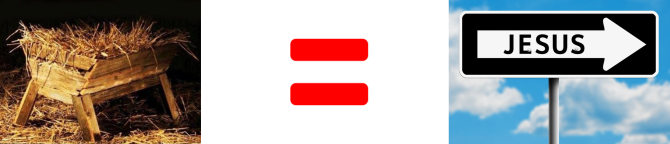
A manger and equals sign and a signpost pointing to Jesus.

If we focus on the signpost, the pointer, and not what it’s pointing to, we miss the point. And, more to the point, we may fail to point others to the thing we’re supposed to be pointing to!

So, what’s my point?

Well it depends on how you personally relate to Jesus. Are you like the shepherds at the beginning of the story, needing to follow signposts to Jesus, or like the shepherds at the end of the story, after they’d found Jesus, when they became signposts themselves, pointing others to what they’d found.

Let me talk to the second group first. You’ve discovered Jesus. You might call yourself a Christian, or a follower of Jesus or by some other label. But the point is, are you a good signpost, because if we’re not pointing to Jesus we’re not doing a great job.

So…does the way I live point to Jesus, the way I treat others (especially the poor, the refugee, the marginalised) point to Jesus? Do the things I say, the way I use my money and possessions point to Jesus. Do I resemble Jesus…do people see his likeness in me?

There are other signposts to Jesus, all good in themselves, but we’re in trouble if we focus on the signposts and not the one they’re pointing to. It can seem to those looking on that we’re focussing on, maybe even worshipping the signpost not Jesus. So in no particular order, the Bible, church attendance, a particular set of beliefs, a particular style of worship or a specific spiritual experience, all, as I said, good signposts, sometimes become the focus of our faith journey and not a help on the way to Jesus.
I hope you get my point!

And to the first group, if you haven’t found Jesus yet, remember first of all that he didn’t stay as baby Jesus…he grew up…lived an amazing life…died on a cross (he said it was for you and me)…then he defeated death itself and came back to life because he was the Saviour, Immanuel (God with us). What’s more, thousands of people down through history and today say they’ve got to know Jesus. We’re either deluded or crazy or maybe, just maybe…

So what about you? What signposts to Jesus are you following? The Bible, church and the other things I mentioned above are all good ways to begin checking out the Jesus story, but by far the best signpost is another person who’s been on the journey you’re on and has found Jesus. Do you have any friends who are like Jesus…who are good signposts? Maybe a conversation with them might be a good starting place.

Don’t miss out…either in following the signposts and finding Jesus or in being a good signpost yourself…there’s more at stake than just losing your way on a holiday trip!

If you want to share this:

  • Email a link to a friend (Opens in new window) Email
  • Print (Opens in new window) Print
  • Share on Reddit (Opens in new window) Reddit
  • More
  • Pocket
  • Share on Threads (Opens in new window) Threads
  • Share on WhatsApp (Opens in new window) WhatsApp
  • Post
Like Loading...

A review of “Domestic Monastery” by Ronald Rolheiser

Posted by David Ward on 08/08/2025
Posted in: aging, Books/Articles, Contemplative spirituality, Monastic spirituality, Spirituality, Spititual Practices, wisdom. Tagged: Christian, death, domestic, monastic, parenting, Ronald Rolheiser, stages of life. Leave a comment

I’ve read a few Rolheiser’s books in the past but wasn’t aware of this one until it was referred to in Emma Timms’ book that I reviewed recently. It is potentially a quick read, coming in at 89 pages, but it’s worth taking more time to appreciate some of the gems it contains.

Ronald Rolheiser is a Canadian priest, born in 1947, who lives in San Antonio, Texas, where he teaches at the Oblate School of Theology. He writes extensively on contemplative life and spirituality.

In this slim volume Rolheiser discusses the possibility of being contemplatives in everyday life, however we live that out. It is certainly not, he suggests, a thing that’s only possible for monastics who retreat from the world to focus on a life of prayer and service, although there may be lessons to learn from the monastery. In short and practical chapters, he looks at topics like Real Friendship, Ritual for Sustaining Prayer, A Spirituality of Parenting, The Seasons of Life and Life’s Key Question, among others. He is not afraid to ask challenging questions and to open up the conversation around them.

The blurb on the back cover sums it up well:

“A monastery is a place set apart – to learn that powerlessness brings blessings and that time is not ours, but God’s. Monastics do this by physically withdrawing from the world. But in this book, Ronald Rolheiser shows how our domestic life at home and at work can, like life in a monastery, teach us these things.”

My favourite takeaway from the book lies in a question once asked by an elderly monk, “Give me some hints on how I should prepare to die! What should I do to make myself more ready for death?”

“Had that old monk cornered Jesus and asked him the same question he asked me, I suspect Jesus might have said:
Prepare for death by living more fully now.
Work at loving more deeply, less discriminately, more affectionately, and more gratefully.
Tell those close to you that you love them and death will never catch you like a thief in the night.”

If you want to share this:

  • Email a link to a friend (Opens in new window) Email
  • Print (Opens in new window) Print
  • Share on Reddit (Opens in new window) Reddit
  • More
  • Pocket
  • Share on Threads (Opens in new window) Threads
  • Share on WhatsApp (Opens in new window) WhatsApp
  • Post
Like Loading...

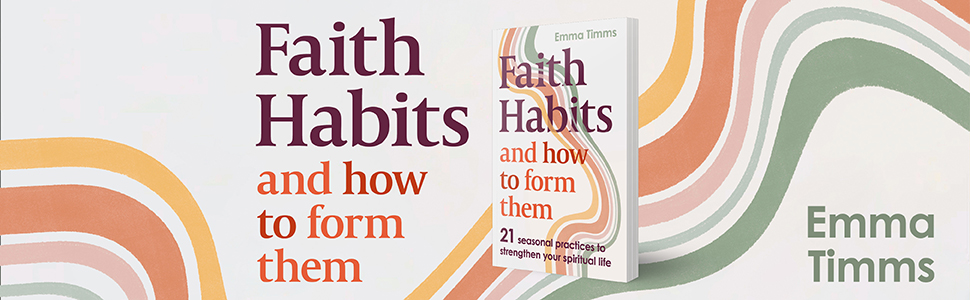
A review of “Faith Habits and how to form them by Emma Timms

Posted by David Ward on 23/07/2025
Posted in: Books/Articles, discipleship, Spirituality, Spititual Practices. Tagged: discipleship, Emma Timms, Faith Habits, Rule of Life, Spiritual disciplines, spirituality. 1 Comment

I’ve read a lot of books about spiritual disciplines and developing a rule of life over the years. Emma’s book stands out because of its deliberate simplicity, it’s tone of practical reality and it’s guilt-free introduction to habits that will make a difference as we seek to draw closer to Jesus and more closely resemble him in our everyday lives.

It is a vulnerable book, where Emma shares some of her story and her changing relationship with faith habits over the years, finding new practices and rhythms as she adjusts to seasons of life and family.

The book begins with Emma sharing her faith story and gradual discovery of helpful Faith Habits, especially the development of a Rule of Life. She goes on to briefly outline the neuroscience of habit formation before asking the reader to consider why they are interested in pursuing faith habits.

This is followed by a brief look at some monks, saints and mystics and their experiences of a rule of life and faith habits before looking in more detail at some of the practices themselves. These are very helpfully split into daily, monthly and yearly practices, which Emma suggests may vary throughout the seasons of the year and through different stages of life.

This exploration is never prescriptive and always personal, as we are encouraged to “try it and see” before deciding which habits to develop.

I particularly like the section where Emma discusses what she calls different stages of life…life events such as raising young children, chronic illness, transitions, caring and intense study or workload. We all experience time like this, and it’s good to be reminded that God loves us and wants to be alongside us in these circumstances when we may find it difficult to feel close or even aware of God’s closeness, let alone engage in Faith Habits!

The book is rounded of by what Emma calls a Workbook, although don’t be put off by the title. It gives the reader examples and a helpful template for putting together our own rule of life, once again in Emma’s do-able and non-guilt inducing style.

If you want to know more about Emma and the resources she offers you can go to her website HERE and her Facebook page HERE.

If you want to share this:

  • Email a link to a friend (Opens in new window) Email
  • Print (Opens in new window) Print
  • Share on Reddit (Opens in new window) Reddit
  • More
  • Pocket
  • Share on Threads (Opens in new window) Threads
  • Share on WhatsApp (Opens in new window) WhatsApp
  • Post
Like Loading...

Posts navigation

← Older Entries
  • Recent Posts

    • Missing the Point(er)… 22/12/2025
    • A review of “Domestic Monastery” by Ronald Rolheiser 08/08/2025
    • A review of “Faith Habits and how to form them by Emma Timms 23/07/2025
  • Archives

  • Blogs I follow

    • Downtown Monks
    • Far From Home
    • Northumbrian Collective
Website Built with WordPress.com.
Pilgrim Traveller
Website Built with WordPress.com.
  • Subscribe Subscribed
    • Pilgrim Traveller
    • Join 105 other subscribers
    • Already have a WordPress.com account? Log in now.
    • Pilgrim Traveller
    • Subscribe Subscribed
    • Sign up
    • Log in
    • Report this content
    • View site in Reader
    • Manage subscriptions
    • Collapse this bar
 

Loading Comments...
 

    %d