
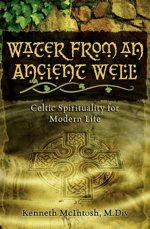
 “Water from an Ancient Well – Celtic Spirituality for Modern Life” by Kenneth McIntosh, Anamchara Books, New York 2011 ISBN 978-1-933630-98-4
Before I begin to write my review of the work in hand (another gift from “Anamchara Books) I have a confession to make.
Lots of the ‘spiritual writers’ from the USA whose books I read, constantly made references to Annie Dillard and “Pilgrim at Tinkers Creek”. It was there in Dallas Willard and again in the books of Robert Benson. So I thought that as it came with such high recommendation I should take a look.
When I did I was surprised at how much I disliked Dillard’s book. Above all, I found it to be an exercise in self-indulgent wordiness, rather than the pithy classic I had been led to expect. Maybe I just wasn’t ready for it!
I also have a problem with people who write devotional books and feel the need to display their academic qualifications on the cover…I can understand if it’s an academic textbook, but a devotional book…maybe it’s a Brit thing.
As my readers will already have caught a whiff of where this might be going it’s probably only fair to begin with the things I struggled with in the book “Water from an Ancient Well”, by Kenneth McIntosh, M Div. (it says so on the cover). However, I would like to ask you to read to the very end of this review before you draw your own conclusions.
Apart from the qualifications-on-the-cover thing I did find the book a bit wordy and hopelessly romantic and sentimental at times. The Celts were and are a gritty, earthy people, and far too much that 21st century re-constructors write often avoids the toughness and harshness of their environment and the faith it nurtured (and I confess that I may have been guilty of this a times too).
That said, and it was said at the risk of sounding ungrateful for a gift book but with an awareness that I’ve probably been sent the books to see how they feel to a reader from British culture (I’ve read American reviews, that seem to suggest that the booked is pitched just right for that audience), and therefore need to be honest, there is much about the book that I liked.
The author writes thematically, choosing a topic which is then illustrated with stories of saints’ lives, insights into the author’s own spiritual practices and experiences and frequent links to life today and the relevance of Celtic Christian spirituality to us. The themes are well chosen, and include chapters on divine romance, the meaning of the cross (liked this one!), solitude, community, the arts, hospitality and pilgrimage.
In this format and approach, he joins two British authors whose books have become classics of this kind of literature – “Restoring the Woven Chord – Strands of Celtic Christianity for the Church Today”, by Michael Mitton, DLT, London 1995 and “Exploring Celtic Spirituality – Historic Roots for our Future”, by Ray Simpson, Hodder & Stoughton, London 1995. The book also bears a passing resemblance to the works of Edward Sellner (especially the storytelling). As these authors have long been standards for my writing and teaching it was inevitable that a new work would be compared to them.
McIntosh is an excellent storyteller, who has clearly worked hard to research both his stories and the facts of history, even if he does, in my opinion, lean towards a tendency to sentimentalise. He has a good grasp of the period. The applications to modern living are interwoven with the broader text, so the reader has to work a bit in order to follow the thread, draw conclusions and find ways to incorporate the ideas into their own spiritual life and practice. Helpful suggestions are made within the text for ways of following through on the spiritual practices. The chapter notes at the end of the book provide ample suggestions for further reading, and there is a helpful index – I wish more writers of small devotional volumes of this kind would include an index!
I liked the book, and despite my own, rather personal and perhaps a bit picky, misgivings, this is a book I would put into the hands of others who are looking for a good introduction to the breadth of ancient Celtic Christian spirituality and for ways to connect with that today. It is worth it for some of the storytelling alone…

 Pilgrim Traveller