

Because it’s a musical
A musical
And nothing’s as amazing as a musical
With song and dance
And sweet romance
And happy endings happening by happenstance
Bright lights, stage fights, and a dazzling chorus
You wanna be great?
Then you gotta create a musicalFrom: ‘Something Rotten’
My youngest daughter is into musicals in a big way. She watches them, preferably live, but failing that, DVDs or YouTube are just fine. The soundtracks are constantly playing in her room or in our car. She knows the words and sings along. I suspect that, in the privacy of her room, she probably performs one-girl shows with word-perfect dialogue. She’s currently rehearsing for a part in both ‘Bugsy Malone’ and ‘Oliver’. She has converted many of her friends into musical-lovers too.
As a consequence of her musical adoration, I too have become very familiar with the songs (but I’m never allowed to sing along…she is the equivalent of the Musical Secret Police). Some of them truly move me, and I’ve been mocked more than once for having eyes glistening with tears.
I have come to realise, however, that you can learn a lot from a good musical.
Family life, relationships, social history, politics, propaganda, intrigue and faith all have their place. Musicals have filled my head with ideas and experiences as I’ve watched the actors and absorbed the lyrics.
Take, for example, ‘Shrek’, for a long time one of her absolute favourites. We learned that even the most hideous ogre can be loved and lovable, which gives us all hope, and loyalty and friendship can be found in the most unlikely places and the most unlikely people.
“Hamilton”, which has proved to be a very popular musical gives us some glimpses of the founding of the USA through the story of a hitherto largely overlooked Founding Father, Alexander Hamilton. It shows us a country birthed in violence whose leaders cannot agree right from the outset. It also draws our attention to the vital role played by immigrants like Hamilton and Lafayette in the war to oust the British and the subsequent government of the nation (“Immigrants – we get the job done”).
‘Wicked’ turns the well-loved story of “The Wizard of Oz” into an example of how fake news and propaganda can make the good seem bad and the truly wicked appear to be the heroes…it is frighteningly contemporary.
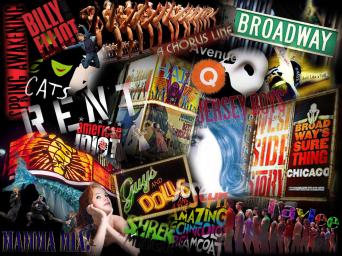
“Les Miserables” shows us the underclass of French society in the 1700s. It is a classic tale of the struggle between ‘law’, personified in Javert and ‘grace’, first offered to Valjean by the Bishop but becoming the underlying theme of much of the story.
Billy Elliott shows us gender roles and the Miners’ Strike in the 1980s, while more recent musicals, like “Rent” and “Newsies” are about poverty, sexuality, exploitation friendship and hope. One of my personal favourites is “Dear Evan Hansen”, featuring two dysfunctional families brought together by the death of Connor Murphy. Themes of dreaming of a better life, lies that get out of control, grief and regret are woven together into a powerful story about what makes us significant and loveable. It has one of my favourite songs in “I will sing no requiem”, a true lament of Biblical proportions.
What is it about musicals (or the books, plays and movies that birth them) that makes them so powerful.
David Putnam, the Producer of “Chariots of Fire” (not yet a musical) remembered:
“Far more than any other influence, more than school, more even than home – my attitudes, dreams, preconceptions and pre-conditions for life had been irreversibly shaped five and a half thousand miles away in a place called Hollywood.”
Ken Gire, in “Windows of the Soul” (see blog post on 30.12.2016), describes movies as “a window through which God speaks”, which by extension, applies to musical theatre too. Some-how they show up our own experiences and help us to, perhaps, make more sense of them. They also enable us to lose ourselves in someone else’s story, and by losing ourselves, we find ourselves again (sounds like something Jesus said about losing our lives to find them!).
Like a movie, a musical is able to:
“…reflect at a very fundamental level, the longings of the soul: the longing that good triumphs over evil, that truth wins out, that the drama of life brings out the hero in us, that a good character in the course of the drama grows better, wiser, more understanding, and that a bad character, if not redeemed is at least brought to justice, and that in the end there is a happy ending, which is none other than a dim reflection, I think, of our longing for heaven.” Ken Gire
Like so many expressions of truth through art, musicals are deeply subversive They have the power to really get under your skin in a way that mere words and pictures ever can, with lyrics that are so memorable and sing-able that they take a lot of forgetting or ignoring, and break down our barriers of prejudice and pre-conception. And as we change our ideas, and see ourselves more clearly, we have the opportunity to become different people, and more important we may begin to behave differently.
And, perhaps, we may even become more capable of hearing the quiet whisper of the Spirit of God drawing us into an ever-deepening relationship with Jesus.
Because after all, if all truth is God’s truth, sometimes God uses unexpected people and unexpected ways to make sure we get it…


 Band line-ups came and went, and eventually I spent a long time working as a solo singer/songwriter, before eventually giving up my day job as a teacher to work for British Youth for Christ as a member of their national staff band ‘Alphabet’.
 ertain when it was; it must have been some time in the early 1960s.
 Pilgrim Traveller