Pilgrim Traveller

thoughts on life’s journey…

  • About

The Reformers…

Posted by David Ward on 23/07/2010
Posted in: Pilgrimage, Theology. Tagged: Bible, condemnation, forgiveness, Holy Land, John Calvin, Martin Luther, Pilgrimage, Puritans, Reformers, sacred journey, saints, scriptures, Zwingli. 1 Comment

zwingli john-calvin martin-luther

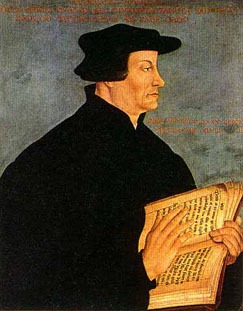
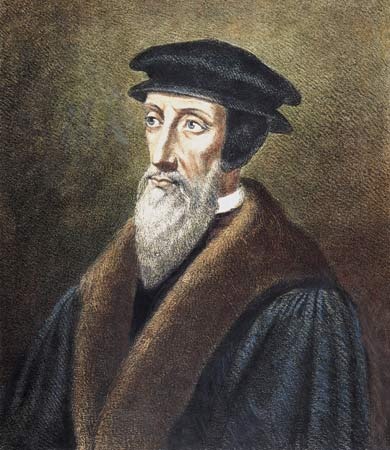
As might be expected, Zwingli and his followers were extreme in their condemnation of both pilgrimage and shrines and relics. For Calvin, pilgrimage itself was less of an issue, although he condemned the cult of the saints and images. This reflects his church-style, where church was a place of learning from the sacred book, not a sacred space in its own right. Pilgrimage had to do with meeting with fellow believers in the here and now, rather than trying to contact the saints of the past. And it certainly had nothing to do with earning God’s favour or forgiveness.

It is Martin Luther who seems to have most vehemently condemned pilgrimage and the associated practises. In his view, in the past Christ had been represented as an awesome judge, rather than a loving saviour, and that as a result “ all pilgrimages and the invocation of the saints stem from this view of Christ” (from a sermon on John’s Gospel).

He didn’t like images or the cult of the saints, but his strongest criticisms were reserved for indulgences and other ways of seeking to do good works to earn forgiveness.

His views on pilgrimage may be summed up by two quotes, which may be summarised as saying that pilgrimage is pointless and dangerous, and that true pilgrimage is an inner journey motivated by studying the scriptures.

“All pilgrimages should be stopped.There is no good in them: no commandment enjoins them, no obedience attaches to them. Rather do these pilgrimages give countless occasions to commit sin and to despise God’s commandments.” (from “To the Christian nobility”)

“In former times, saints made pilgrimages to Rome, Jerusalem and Compostela in order to make satisfaction for sins. Now, however, we  can go on true pilgrimage in faith, namely when we diligently read the psalms, prophets, gospels and so on. Rather than walk about holy places, we can thus pause at our own thoughts, examine our hearts and visit the real promised land and paradise of eternal life.”

The Puritans in the UK seem to have thought in a very similar vein to Luther, whose works lead to the virtual ending of pilgrimage in the protestant world for many years, probably until in the nineteenth century protestants began to travel to the Holy Land, which in turn led to a new openness towards pilgrimage, which has, along with other cultural changes, led to a great resurgence in our own century.

If you want to share this:

  • Email a link to a friend (Opens in new window) Email
  • Print (Opens in new window) Print
  • Share on Reddit (Opens in new window) Reddit
  • More
  • Share on Threads (Opens in new window) Threads
  • Share on WhatsApp (Opens in new window) WhatsApp
  • Post
Like Loading...

On the eve of the Reformation

Posted by David Ward on 18/07/2010
Posted in: Pilgrimage, Theology. Tagged: Erasmus, Faith, God, inward journey, John Wyclif, Lollards, outward journey, Pilgrimage, Reformers, spiritual discipline. Leave a comment

lollards

John Wyclif (c1329-1415) and the Lollards

John Wyclif regarded pilgrimage as ‘blind’, as Christ is everywhere ready to tale away sin. He also considered that pilgrimage did little to help the poor, and condemned the lechery which often accompanied pilgrimage. This demonstrates the extent to which pilgrimage was considered a sin-forgiving good work, accompanied by the earning or purchase of ‘indulgences’. He also considered the idea that  a relic or image possessed some special virtue to be idolatrous:

“It is evident that images may be made both well and ill: well in order to rouse, assist and kindle the minds of the faithful to love God more devoutly; ill when by reason of images there is a deviation from the true faith, as when an image is worshipped”

Wyclif’s English followers, the Lollards, were very critical of pilgrimage, indulgences and all images and relics. They were part of a contemporary movement which interiorized religion, and as part of that considered only pilgrimage ‘of the heart’ rather that the need for a geographical journey. A Lollard Tract called The Lanterne of Light (1409/10) talks about how “true pilgrimage is done in six manners’:

  1. We are pilgrims from birth on our way to the heavenly city.
  2. We are pilgrims when we go to church.
  3. We are pilgrims when we visit the poor and distribute alms.
  4. We are pilgrims when we study holy writ and go to proclaim it.
  5. We are pilgrims when we go to a place where there is no priest, at the direction of God, as did Abram.
  6. We are pilgrims when we enter death, to ‘bliss or pain’.

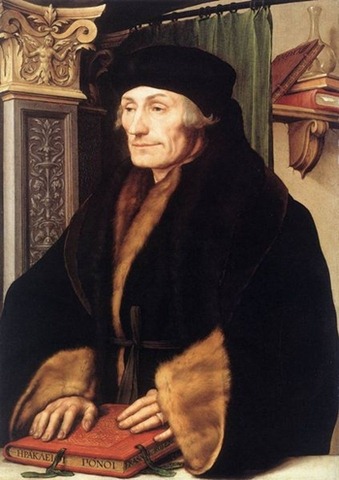
erasmus Erasmus of Rotterdam (c1466-1536)

Erasmus was one of the first to clearly bring out the vital importance of the parallel between the outward physical activity of travelling to shrines and the internal spiritual cultivation of the Christian character…the outward journey acts to facilitate the inward journey, and the outward without the inward is pointless as a spiritual discipline (my italics).

“You venerate the saints; you are glad to touch their relics. But you condemn what goods they have left, namely the example of a pure life.No worship of Mary is more gracious than if you imitate Mary’s humility. No devotion to the saints is more acceptable and more proper than if you strive to express their virtue. You wish to deserve well of Peter and Paul? Imitate the faith of the one, the charity of the other – and you will thereby do more than if you were to dash back and forth to Rome ten times. “

From ‘Enchiridion’ (1503)

Although Erasmus did not join the Reformers, he was a moderate, anxious to condemn and reform abuses within the church, and his thinking helped to form many later Protestant attitudes.

If you want to share this:

  • Email a link to a friend (Opens in new window) Email
  • Print (Opens in new window) Print
  • Share on Reddit (Opens in new window) Reddit
  • More
  • Share on Threads (Opens in new window) Threads
  • Share on WhatsApp (Opens in new window) WhatsApp
  • Post
Like Loading...

Meditation on the Communion Service

Posted by David Ward on 17/07/2010
Posted in: Pilgrimage, Theology. Tagged: communion, God, Pilgrimage. Leave a comment

Thomas a Kempis.jpg

These words come from Thomas à Kempis (c1379-1471) meditation on the communion service, and give yet another medieval insight on attitudes to pilgrimage.

” Many run to divers places to visit the memorials of saints departed, are full of admiration at hearing of their deeds, behold with awe the spacious buildings of their temples, and find their affections moved by whatever is connected with their memory.

But, behold, thou art thyself here present with me on thine alter, my God, Saint of saints, creator of men, and Lord of the angels.”

If you want to share this:

  • Email a link to a friend (Opens in new window) Email
  • Print (Opens in new window) Print
  • Share on Reddit (Opens in new window) Reddit
  • More
  • Share on Threads (Opens in new window) Threads
  • Share on WhatsApp (Opens in new window) WhatsApp
  • Post
Like Loading...

Posts navigation

← Older Entries
Newer Entries →
  • Recent Posts

    • Missing the Point(er)… 22/12/2025
    • A review of “Domestic Monastery” by Ronald Rolheiser 08/08/2025
    • A review of “Faith Habits and how to form them by Emma Timms 23/07/2025
  • Archives

  • Blogs I follow

    • Downtown Monks
    • Far From Home
    • Northumbrian Collective
Website Built with WordPress.com.
Pilgrim Traveller
Website Built with WordPress.com.
  • Subscribe Subscribed
    • Pilgrim Traveller
    • Join 105 other subscribers
    • Already have a WordPress.com account? Log in now.
    • Pilgrim Traveller
    • Subscribe Subscribed
    • Sign up
    • Log in
    • Report this content
    • View site in Reader
    • Manage subscriptions
    • Collapse this bar

Loading Comments...

    %d