Pilgrim Traveller

thoughts on life’s journey…

  • About

Zephaniah part 2 – “JUSTICE AND LOVE”

Posted by David Ward on 06/03/2021
Posted in: Bible, Personal thoughts. Tagged: Ancient Prophets:Modern Message, Bible, minor prophets, Old Testament, Zephaniah. Leave a comment
Zephaniah – hope for the humble

Zephaniah paints a picture of an alternative future, where hope for our world is found in God’s justice and love.

Read: Zephaniah 3: 9-17

Although Judah failed to turn back to God in time to avert the disaster of the Babylonian invasion and exile, these turned out to be the route to forgiveness and restoration for people who were humbled by the experience and returned to God, and ultimately were allowed to return to their own land.

Throughout this book, two seemingly contradictory characteristics of God have competed for our attention: his judgement and mercy (or his justice and love).

The world is not the way God planned it to be. It was made “very good” in God’s eyes, but because of human rebellion and sin, has been spoiled and broken.

God expresses his justice as a passion to rescue his world and his people from human evil and violence and his love by creating a future world where everything can flourish in safety and peace. Just as the book of Zephaniah begins with a sort of reverse Creation story, so it ends with a new Garden of Eden story, where God is once again living among his people.

But all this comes at a price. The place where God’s justice and love come together in perfect harmony is a cross on a hill, where the Messiah suffers and dies for the sins of the world. God himself lovingly satisfies his own justice in the person of Jesus, many years in the future from Zephaniah’s day. In the short term, this future event ensures Judah’s release from exile and return to their own land, but ultimately it provides a way to become part of God’s Kingdom, part of a new creation.

If we are new creations, part of God’s Kingdom on earth, how does this affect every part of our lives, from home and family to work and politics? What part are we playing in experiencing and sharing God’s Kingdom on earth as it is in heaven?

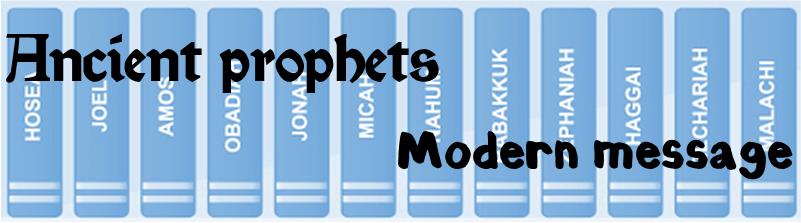
From here onwards, instead of posting to the blog each day posts will be made once a week, on a Monday. This will keep us in step with the “Ancient Prophets:Modern Message podcast on Anchor Podcasts. This will begin with Haggai part 1 on Monday 8th March 2021.

If you want to share this:

  • Email a link to a friend (Opens in new window) Email
  • Print (Opens in new window) Print
  • Share on Reddit (Opens in new window) Reddit
  • More
  • Pocket
  • Share on Threads (Opens in new window) Threads
  • Share on WhatsApp (Opens in new window) WhatsApp
  • Post
Like Loading...

Zephaniah part 1 – “GENESIS IN REVERSE”

Posted by David Ward on 05/03/2021
Posted in: Bible, Personal thoughts. Tagged: Ancient Prophets:Modern Message, Bible, minor prophets, Old Testament, Zephaniah. Leave a comment
Zephaniah – hope for the humble

Zephaniah paints a bleak picture of the coming Day of the Lord and what it will mean for the whole world…with no exceptions.

Read: Zephaniah 1: 2-6

Zephaniah is possible the bleakest of all the minor prophets. His message begins with what sounds like a reversal of the Creation story and a repeat of the Genesis Flood, with God destroying everything he has created. Zephaniah speaks about the Day of the Lord, a theme picked up by several of the minor prophets. The Jews had assumed that the Day of the Lord would be a time when God protected them and raised them up as his favourites over the other nations of the world, but Zephaniah makes it clear that if the people of Judah are no different to the other nations, they will be treated in the same way.

****************************

Zephaniah was a distant relative of King Hezekiah, and therefore of King Josiah, during who’s reign (from 640 to 609 BC) he prophesied. As such, he was strategically placed to have a listening ear in the court of the king.

There is discussion about when exactly in Josiah’s reign he prophesied, early or late, by looking at various clues in Zephaniah’s message. This matters, because the state of Judah, the southern kingdom at the time reveals something of the way the message was received. Let’s look at the later history of the kingdom of Judah.

King Hezekiah responded positively to the prophecies of Joel and Isaiah and reformed the social and religious life of Judah. As a result, the kingdom was rescued by God from the invasion of the Assyrian army in 701 BC.

Unfortunately, when Hezekiah died 15 years later, he was succeeded by his son Manasseh, who was possibly the most evil king to ever sit on the throne of the southern kingdom. He introduced the worship of several pagan gods, most notably Baal, Asherah and Molech, and embraced black magic and child sacrifice. He conducted a purge of anyone who spoke out against him, including the prophet Isaiah according to a much later apocryphal text, a collection of traditional stories about Isaiah called the Ascension of Isaiah.

On Manasseh’s death his son Amon continued the bad work until he was assassinated 2 years into his reign and succeeded by his son Josiah, who was 8 years old. When he was 16, he turned to God in a big way He personally read the Law of Moses publicly in the Temple courtyard and urged the people to turn back to God and keep their agreement with him.

This is the point at which we need to return to the question of whether Zephaniah prophesied early or late in Josiah’s reign.

If he prophesied early, then it’s likely that his words were instrumental in Josiah’s turning to God and the subsequent return of the people to the faithful worship of Yahweh.

If he prophesied later in Josiah’s reign it’s likely that he’s pointing out that the apparent changes in behaviour of the people were really only superficial, and that under the surface the worship of other gods and the evil behaviour of the people, especially the rich, continued unabated.

Either way, at the end of his reign Josiah unwisely joined an invasion of Egypt and was killed with many of his soldiers in battle. As a result, a very weakened Judah was soon overrun by Babylon, the super-power of its day, in 586 BC. It seems that Josiah’s attempts at reforms had come too late to save the people of Judah from their rebellion against God. And yet, defeat and exile turned out to be the route to forgiveness and restoration.

Zephaniah is a warning to those who think that following Jesus is just about a tick list of things to believe in order to be “in”. It seems that God is less concerned about our creeds and professions of orthodoxy, or our loud and showy worship. He’s more concerned with what’s going on beneath the surface of our lives. Are we allowing God’s spirit to change us and make us more like Jesus?

If not, God loves us too much to let us get away with hypocritical and superficial faith. Sometimes hard things we go through are expressions of God’s love that refuses to give up on us!

If you want to share this:

  • Email a link to a friend (Opens in new window) Email
  • Print (Opens in new window) Print
  • Share on Reddit (Opens in new window) Reddit
  • More
  • Pocket
  • Share on Threads (Opens in new window) Threads
  • Share on WhatsApp (Opens in new window) WhatsApp
  • Post
Like Loading...

Habakkuk part 6 – “TWO PRAYERS”

Posted by David Ward on 04/03/2021
Posted in: Bible, Personal thoughts. Tagged: Ancient Prophets:Modern Message, Bible, Habakkuk, minor prophets, Old Testament. Leave a comment
Habakkuk – from questioning to trusting

Habakkuk ends his journey from questioning to trusting by singing a psalm about God rescuing and delivering his people.

Read: Habakkuk 3: 1-2 and 17-19

Most of chapter 3 of Habakkuk is given over to a psalm that Habakkuk sings (there are even instructions to the choir director about accompaniment, so it was clearly written to be sung…Habakkuk isn’t just writing God’s message down so it can be spread around, he’s turned it into a contemporary praise song as well.

It paints a picture of a God who is totally committed to the rescue and deliverance of his people from their enemies, who is rushing to their aid in a terrifying display of his glory and power. When Habakkuk thinks about the way God acts, he says that “I trembled inside when I heard this, my lips quivered with fear. My legs gave way beneath, me and I shook in terror.” Perhaps he had realised that if God dealt with Judah’s oppressors in that way, if Judah in turn behaved as aggressors and oppressors they may find themselves facing God’s judgement too.

For me, however, two prayers stand out, two prayers to be prayed in difficult times when God seems absent or disinterested in the things that are happening in our world.

The first, in 3:1-2 is a prayer for mercy. This cuts to the very core of God’s revelation of himself to Moses on Sinai, in Exodus 34: 6-7. “Yahweh! Yahweh! The compassionate and gracious God, slow to anger, abounding in love and faithfulness”. The more we become aware of God’s awesome character and actions, the more we become aware of our need for God’s mercy and grace…mercy and grace that he freely gives because it is the very essence of who God is.

The second prayer is in 3: 17-19. It is real evidence of just how far Habakkuk has come on his journey from questioning to trusting God. In this part of his psalm he sings that, no matter how hopeless and difficult times may be, he will not only trust but rejoice in God, who will strengthen and save him, the God who has taken him from the valley of despairing questions to the heights of trusting.

Merciful God, shine your light of truth into me in the coming weeks and months, that I might more clearly understand what you’re like and how you see me. Let my fears and pride be exposed for what they are, and keep them from distorting my picture of who you are. Give me courage, that I might face my true self, and hope, that I might face you. Help me to see in you what Habakkuk saw when he asked “and in your anger, remember mercy.”
AMEN

This prayer is taken from The Message//Remix: Solo, Day 188

Pray that prayer regularly. How does it affect not just the way you see yourself and God, but what does it say to you about the way you should behave towards other people, especially as you demonstrate God’s mercy to everyone you meet, especially the really difficult people who God sends your way!

If you want to share this:

  • Email a link to a friend (Opens in new window) Email
  • Print (Opens in new window) Print
  • Share on Reddit (Opens in new window) Reddit
  • More
  • Pocket
  • Share on Threads (Opens in new window) Threads
  • Share on WhatsApp (Opens in new window) WhatsApp
  • Post
Like Loading...

Posts navigation

← Older Entries
Newer Entries →
  • Recent Posts

    • Missing the Point(er)… 22/12/2025
    • A review of “Domestic Monastery” by Ronald Rolheiser 08/08/2025
    • A review of “Faith Habits and how to form them by Emma Timms 23/07/2025
  • Archives

  • Blogs I follow

    • Downtown Monks
    • Far From Home
    • Northumbrian Collective
Website Built with WordPress.com.
Pilgrim Traveller
Website Built with WordPress.com.
  • Subscribe Subscribed
    • Pilgrim Traveller
    • Join 105 other subscribers
    • Already have a WordPress.com account? Log in now.
    • Pilgrim Traveller
    • Subscribe Subscribed
    • Sign up
    • Log in
    • Report this content
    • View site in Reader
    • Manage subscriptions
    • Collapse this bar
 

Loading Comments...
 

    %d