It’s now a little over two weeks since Berwick Literary Festival 2018, and much as I’d like it to, I realise that this blog post is not going to write itself. I really want to respond to at least one of the talks I went to at the Festival, but am struggling (as I often do) with a sense of how unable I am to do it justice…
I’ve been a regular visitor to the Festival for at least three years now, and generally pick out sessions about History, Archaeology, Current Affairs or the Great Outdoors, and in previous years have enjoyed readings and talks from authors such as Alistair Moffat (‘Scotland: a history from earliest times’), Max Adams (‘In the Land of Giants’) and Richard Hingley (‘Hadrian’s Wall: a life’)…I particularly enjoyed the talk by Max Adams (a landscape archaeologist) and went on to read all his books.
This year I chose two very different sessions:
My ‘current affairs’ session was a talk by Douglas Alexander, who was an MP for 18 years before taking on his current role as Chair of UNICEF UK, entitled ‘Trump, the transatlantic relationship and the rise of populism’. Whilst I’m not writing about this session in any depth, I do want to record what a pleasure it was to listen to an ex- politician who was knowledgeable, erudite and, well, very nice!
The second talk was by an author I had not heard of, called Neil Ansell, who would  provide my ‘outdoor’ session as he talked about his book, “The Last Wilderness”.
I don’t always manage it, but I made a point of reading his book in the week running up to the talk…seemed only polite…and I was captivated on so many levels.
Although, on the surface, the book is about a series of flesh and blood journeys around a wild area of the west coast of Scotland, the Rough Bounds, that the author visited decades ago, also present is an interior journey into the unknown wilderness of loss, aging and dying. This is why, for me, this is very much a book about a pilgrimage. The descriptions of his experiences, courage and moments of insight made me want to meet the man…so I booked for his session.
I was not disappointed.
Neil is a self-effacing, single parent with two daughters, who lives on the south coast of England. He had travelled up to Berwick that day in order to give his one hour talk and was travelling back as soon as he had finished…which seemed no big deal to this seasoned traveller at all. He seems very at home in his own skin, which showed as he shared aspects of his life and travels in a friendly and welcoming way, and seemed adept at getting to the heart of any question asked by a member of the audience, using appropriate readings from his book.
Although, as I said, I had read the book prior to attending the talk, his readings, with their personal comments and applications made several bits really come alive to me.
I don’t want to spoil the book for other readers by saying too much, but I’d like to give just a few snippets, focussing on the interior journey, hopefully as a way to increase your interest.
The sub title of the book is ‘A Journey into Silence’. Early in the book he tells us that:
“I have been deaf in one ear since infancy, and the hearing in what I call my ‘good’ ear is severely compromised too, and is rapidly deteriorating.”
This experience leads to many thoughts on loss and aging as the narrative develops. For example, as he observes flights of common sandpipers on the loch shore, he writes:
“And they call their piercing, insistent call, which for me has always been emblematic of summer in the uplands. But not any more. For me they are no longer sandpipers, for me they are just sand – -. I can scarcely believe that I have now lost such a shrill, loud call. It feels as if my world is being dismantled around me, piece by piece…perhaps it makes me value the moment more…and when I see something extraordinary, an eagle or an otter, perhaps, there is a little part of me that cannot help but think, is this my last eagle? Is this my last otter? For in reality it is not the world that is leaving me, it is me that is leaving the world. It is my own absence that I am having to come to terms with.”
I am not personally facing the immanent loss of any of my senses, yet as I age, I often find myself realising that a day will come when I see a creature or a person for the last time, or go to a place I love for the last time ever, and this is no morbid introspection, but rather an encouragement to relish every sight, every place and every relationship that comes my way.
Ansell writes about not allowing the aging process to define and shrink our world unnecessarily:
“When it come to our own decline, it is never a matter of if, only of when. And we all have to work within the confines of our own physical limitations. If I could no longer climb a mountain, then I would climb a hill. And if the only thing that was still a walk in the park was an actual walk in the park, then I would find a park. And when the time came that I could do nothing more than look out of a window, then I hope I would have chosen for myself a room with a view worth watching.”
What had actually led to this particular train of though was the ‘as-yet-undiagnosed’ heart condition that was giving him a lot of trouble on one of his later expeditions, in September. Camped out on the shore, miles from anyone or anywhere, in Knoydart he was awoken by crushing pains in his chest, that no medication would ease.
He spends a long night, alone and at peace with his choices and consequences…
“I walked the strand all night, until the darkness began to have texture, until the first grey light of dawn. The pain in my heart had not gone away, but nor had it got worse. I was still here. The onshore breeze had picked up, and brought with it a sudden squall of rain…I paused and turned towards the sea, spread my arms, turned my gaze to the heavens. Bring it on. Ice cold raindrops lashed against my face; it felt like being alive.”
I immensely enjoyed the journey of the book and the company of the man (albeit briefly), and am motivated and encouraged in life as a result.
That’s not something you could always say!
If you want to share this:



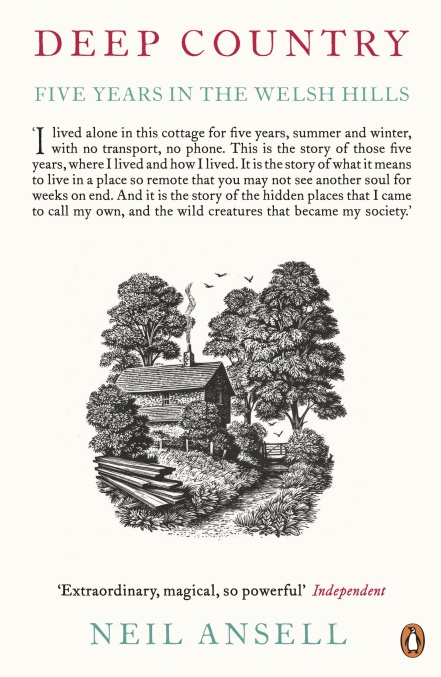 five years in the Welsh hills.” In it he writes about a stay of five years in a remote cottage, without modern services, transport or a phone, a story about wild, remote places and wild creatures that became his society…

 Pilgrim Traveller