‘I am the God of your fathers, the God of Abraham, Isaac and Jacob.’
Acts 7:32 (NIV)
By faith Isaac blessed Jacob and Esau in regard to their future.
Hebrews 11:20 (NIV)
 “Middle-men” do not get great press. They are considered to be an unnecessary and costly intrusion in business dealings (although they can sometimes be invaluable in tricky negotiations). A particularly nasty wi-fi hijack and identity theft is called a “man in the middle attack”, for obvious reasons.
When it came to the ancestors of the nation of Israel, Isaac will forever be the man in the middle. He is chiefly remembered because of the sibling rivalry of his sons, his romance with Rebekah and a dispute over water-rights with his Philistine neighbours in the Negev desert.
He seems to lack the glamour of both his father, Abraham, and his son, Jacob.
He didn’t go on long journeys to far-off lands. He only had one wife and no concubines (as far as we know). He didn’t have his name changed by God, and both his life and his relationship with God seem, well, ordinary, compared to the other two. He also managed to live longer than either of them…maybe there’s a connection to all the other stuff…
And yet, in God’s economy, he had an important and significant part to play, and he and his more illustrious relatives can teach the church today an important lesson when it comes to building things with God that last.
So, Abraham was a pioneer, an innovator. Although they can be uncomfortable to live with, with their tendency to start new things and then move on to the next,we desperately need them in the Kingdom. We have an unchanging God who constantly likes to do old things in new ways. He understands the way that human culture changes better than any of us, and he’s anxious that his church doesn’t get left behind and become irrelevant and side-lined in a rapidly changing world. So he gives us pioneers (maybe apostles in old language…) who catch God’s heart and vision and share it with the rest of us, stirring us up to do old things in new ways through their passion and the vision they share.
But, as I already mentioned, they have the apparently annoying and frustrating habit of abandoning their project and moving on to the next new thing. Left alone, the project would quickly die, and lead to a string of “we tried it; it didn’t work” attitudes.
That’s when Isaac-types come in.
He’s the consolidator of the new vision. He’s the one who works it out, goes deeper and works hard to establish it on firm foundations. He’s the one who makes it work
I see him doing it in three ways.
- He worked out what was worth keeping. In Genesis 24: 1-4 Abraham sends his servant to find a wife for Isaac among their relatives back I the old country, rather than from among the local people they now lived among. Then, In Genesis 28: 1-4 we find Isaac doing exactly the same thing with his son, Jacob. Their identity and heritage as God’s people mattered. When we are doing new things with God, decisions have to be made about what is worth hanging onto from our past history as the people of God and what we need to give up. It’s also important that we don’t start to blend in with people who don’t know Jesus yet so much that we become indistinguishable, and cease to be signposts to Jesus. Isaac’s job was to stay put in the land God had promised, putting down roots and growing there, and still being distinctive.
- He knew when to move on. When he encountered opposition from the Philistines, who kept on filling in the wells he dug, instead of fighting, he let go of the wells and moved on to places where he could dig new ones. And eventually he dug a well in a place no-one contested. Visionaries find it very hard to let go of the dream and move on, often leading to break-ups, splits and the end of something that could have been good. People get tired of opposition (and sometimes it is right to resist) but sometimes we need to name our failure and move on, believing God has something better for us.
- He had an eye on the future. Consolidators know that often they won’t see the fruits of their labours…they build for future generations to benefit. They also know how to make the best out of a bad situation. Isaac’s dysfunctional family could have been a bit of a disaster. When Jacob tricked his father into giving him the blessing meant for the eldest son (Esau), a blessing which could only be given once, Isaac improvised and made up a new blessing for Esau. Both sons were given a blessing for their futures!
And so, we come to Jacob.
Jacob took the vision given to Abraham, and so carefully established by Isaac, and he made it grow. He was the expander, the developer, the builder. His methods weren’t always the one’s God might have chosen but God was faithful and Jacob slowly learned to do things God’s way. He ended up with a large family that found safety from famine in a foreign land and grew there into the great nation that God had promised. They still had to return to the land God had promised, but that is another story.
It might be helpful to read Acts and the Epistles again, and notice how Paul (an Abraham-type, I think) travelled with people and built teams of people who had Isaac and Jacob-type characteristics as he planted new churches. Might be interesting to look at the ministry gifts in Ephesians 4: 11-16 and try to think which gifts an Abraham, an Isaac and a Jacob might have.
In our churches, as we seek to build God’s Kingdom, we need to identify the Abrahams, Isaacs and Jacobs among our members, let them do what they do best and…this is the hard part…get them to work together on God’s plan.

I am, once again, deeply indebted to Lyndall Bywater for her book “Faith in the Making” that has been inspirational and deeply troubling to my personal comfort, and reminded me of my place in God’s scheme of things, which I have found very encouraging.
If you want to share this:


 I was on my way home from an appointment in Melrose and decided to stop off at Harestanes Countryside Visitors’ Centre for a coffee.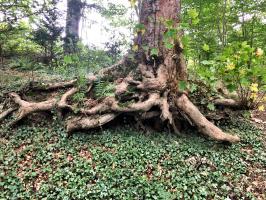
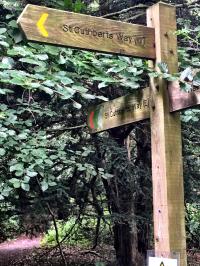 Along the route are several marker posts…the one in the photograph bears the cross for St Cuthbert’s Way, a Roman helmet, because the route is a continuation of Deere Street and the green arrow for one of Harestanes own suggested routes.
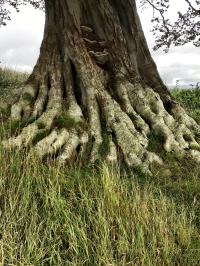 are several magnificent oaks along this path…I sheltered under one when a sudden short, drizzly shower came from nowhere.




 Pilgrim Traveller