Pilgrim Traveller

thoughts on life’s journey…

  • About

ONE – Small steps…

Posted by David Ward on 30/10/2016
Posted in: Community, Personal thoughts, Relationships, unity. Tagged: "God is closer than you think", Church, denomination, Jesus, Juan Carlos Ortiz, KIngdom of God, small steps, suggestions. Leave a comment

warning-copy

For four or five months I taught unity to my congregation, which had grown to about 1, 500 people. At the end, I asked, “How many believe that the church is one?”

Many hands went up.

“Put them down. How many of you really believe the church is one?”

Even more hands were raised.

“How many of you are willing to prove it? To demonstrate this with your own lives?”

Many hands again.

“Good. Next Sunday go to the church closest to your house, whether it’s Catholic, Lutheran, or Presbyterian. Whatever money you normally spend on gas or bus fare to come here, give it to that church’s offering. Only those who live closest to this church come here.”

Silence. They didn’t want to accept the challenge. But a third of the congregation obeyed.

Eventually we gave two hundred people to the Catholic church, fifty-three to the Anglican church and others to other churches. Many good things came of this…

Juan Carlos Ortiz, “God is closer than you think”, p170-171

I felt I needed to begin this blog post with a health warning…once you decide to become part of the answer to Jesus’ prayer, “That they may be one”, it may require you to actually do something about it…and there’s no telling where it will lead.

Living as one church in a locality has certain implications, some of them costly, but ultimately, of great benefit to the Kingdom of God.

So…where do you begin? Here are suggestions of some small steps to make the prayer of Jesus a reality in your life and locality.

  1. Share the prayer

Regularly pray the prayer that Jesus prayed yourself. In many ways, there is more justification to say that this is the real Lord’s Prayerthan the one we have traditionally given that name! (The other one is maybe the Disciples Prayer…) Look for opportunities to become part of the answer to the prayer

  1. Overcome the obstacles

Be determined to accept that no difference is too big to be overcome. Structure your life and the life of your church (if you’re a leader) so you are able to respond freely to the Spirit’s prompting to worship witness and work together.

  1. Find a friend

Seek out another Christian from a different denomination or Christian background to yours. Share your stories of how you came to be a follower of Jesus and the ways you see God at work in your life and in your church.

  1. Worship their way

Get a friend to take you to a worship service at a church that’s very different to yours. Let them make a return visit. Compare notes, ask questions.

If you’re a church leader, close your building down once in a while and go and worship with another church…might be a good idea to warn them in advance. It might be possible to share in the leadership/music/preaching.

  1. Investigate their ideas

Do some research, read some books about their particular beliefs and ways of doing things. My advice would be to try to read what their own members have written about their beliefs, rather than comments and articles by other groups. Many myths about what people believe have been prolonged by passing on inaccurate understanding…this is especially true of the internet, where great care should be taken.

  1. Guard against gossip

However strong the temptation is we should make it a solemn promise that we will never speak badly of another Christian, church or denomination. Sometimes we may feel we have justification or have been sorely provokes…we need to grow in grace.

  1. Forgive each failing

I believe that justice is not about punishment or getting even…ultimately it’s about reconciliation, about trying to restore a broken relationship.

And that’s where forgiveness comes in.

We may feel that we have been hurt, marginalised and misunderstood by a particular person, church or denomination. Grace and forgiveness provide us with the only route to be reconciled…and that’s healing for us as well as for them.

one


If you want to share this:

  • Email a link to a friend (Opens in new window) Email
  • Print (Opens in new window) Print
  • Share on Reddit (Opens in new window) Reddit
  • More
  • Pocket
  • Share on Threads (Opens in new window) Threads
  • Share on WhatsApp (Opens in new window) WhatsApp
  • Post
Like Loading...

ONE – There you have it…

Posted by David Ward on 26/10/2016
Posted in: Communication, Community, Personal thoughts, Relationships, unity. Tagged: Body of Christ, Celtic Christian, honour, ideas, jargon, Jesus prayer, Kenneth Macleod, language, love one another, respect, Robert Benson, Rule of Benedict, that they may be one, The Body Broken, the stranger. Leave a comment

Let all guests who arrive be received as Christ, because He will say: “I was a stranger and you took me in” (Mt 25:35). And let due honour be shown to all, especially to those “of the household of the faith” (Gal 6:10) and to wayfarers.

Rule of Benedict Chapter 53

Let mutual love continue. Do not neglect to show hospitality to strangers for by doing that some have entertained angels without knowing it.

Hebrews 13: 1

jigsaw-pieceI’ve been trying to briefly lay out some of the advantages that result from a positive answer to the prayer that Jesus prayed – “That they may be one…” In this post I want to make a few final comments and general observations before making a few practical suggestions, in the final post of the series, to help us become part of the answer to Jesus’ prayer.

When we become followers of Jesus we become part of his ‘body’ on earth, the hands the feet, the hearts who are called to represent him on planet earth. Effectively we belong not just to Jesus, we belong to each other as well.

It has been said that the USA and UK are two nations divided by a common language…we use the same words but they can mean something completely different in each culture. The same could be said of Christians, who sometimes understand a word or an idea that seems the same in a completely different way. Disastrous misunderstanding can follow. Only by talking to one another, questioning and clarifying can we break down the barriers that our jargon can create (and of course, this is vital as we try to communicate faith within wider culture too).

Exploring our language and vocabulary may be one important step in dismantling the walls of fear, ignorance and pride that have been built between us, as we seek the many things we have in common as followers of Jesus.

All of us need to concentrate much more on the things that we all have in common as followers of Jesus. When there are differences, we need to honour and respect those…”agreeing to differ” falls far short of a oneness of heart and love for Jesus and one another.

The Celtic Christians recognised that often it is in the stranger, the one who is not like us, that we meet Jesus. There is an ancient Celtic rune of hospitality, collected on the Isle of Eigg by Kenneth Macleod, that makes the point:

I saw a stranger yestereen…..
I put food in the eating place
drink in the drinking place
music in the listening place
and in the sacred name of the Triune
he blessed myself and my house,
my cattle and my dear ones.
And the lark said in her song
Often, often, often goes the Christ in stranger’s guise

In the final paragraph of his powerful book, “The Body Broken”, Robert Benson writes:

We must be willing to cultivate humility along with certainty, to practice tolerance along with devotion, to seek patience along with piety.

We must learn to seek the face of Christ in those who are different as readily as we do in the faces of those who are like us.

We must learn to love one another.

reconcile

We must learn to love one another…

If you want to share this:

  • Email a link to a friend (Opens in new window) Email
  • Print (Opens in new window) Print
  • Share on Reddit (Opens in new window) Reddit
  • More
  • Pocket
  • Share on Threads (Opens in new window) Threads
  • Share on WhatsApp (Opens in new window) WhatsApp
  • Post
Like Loading...

ONE – Love or fear?

Posted by David Ward on 24/10/2016
Posted in: Celtic Christianity, Communication, Community, Personal thoughts, Relationships, unity. Tagged: barriers, criticism, difference, excluded, exclusive club, fear, Jesus, Kingdom, lost people, marginalised, margins, pollution, pride, Robert Benson, The Body Broken, unknown, walls. Leave a comment

I do not recall the whole conversation, but one day, however it happened, he said to me, “What is the opposite of love?”

I did not reply straight away. Hate seemed the obvious answer, but I had the feeling that answer was not going to fly. I was right.

“Fear,” he said. “Fear is the opposite of love.”

“This is how they will know that you love me,” said the One Who came among us, “that you love one another.”

And sometimes that begins with not being afraid of one another.

You cannot love those you fear. And we are called to love. Be not afraid.

Robert Benson “The Body Broken”, p97-98

As I said in the previous post, one of the things that makes our faith more real and attractive to others is that sense of our being a more accepting, more inclusive family. So why do we find it so hard to express our ‘oneness’?

fearWhen I read the Gospels I am always surprised by the number of times people are told not to be afraid, from the annunciation by the angel to Mary, right through to the disciples after the resurrection. Fear seems to be such a natural reaction for us mortals…on many of the Gospel occasions fear was the only logical response to the supernaturally unexpected events, but we seem to get fearful about all manner of things that are much less logical.
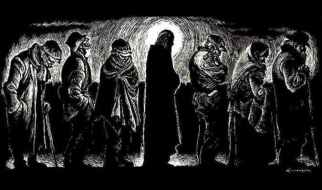
Looking at the church today, I believe that one of the principal things that keeps us apart is a kind of fear driven by pride in our own ‘rightness’.

If our take on the Jesus-story and how we get to be a part of it is the only correct version, then it seems that fear must follow. How so?

It’s fairly easy to identify four areas in which our fear operates (there may be more…).

The first is a fear of that which is different…if my way is the right way and you differ from me you must be wrong. Your different views make me feel uncomfortable, so I must avoid getting too close to you.

The second is a fear of the unknown and the unfamiliar. We do things this way. I like how we do things…it’s to my taste. Your way is unfamiliar or unknown. I feel lost and uncomfortable.

The third is the fear that somehow your views and opinions will pollute me, will make it more difficult to adhere to the strict set of beliefs that constitute the orthodoxy of my tradition, my group.

And finally, if I do start to hear you, to enter into dialogue, to begin to accept that God may be so much bigger than my denomination or group, I run the risk of being criticised, excluded and vilified by others in my group who think I may be compromising, in error or falling away. Sometimes we Christians demonstrate so clearly why we need a Saviour!

Of course, when we exclude people on the basis of a different understanding of the Bible or our doctrines which we fear, we turn the Kingdom of God into an exclusive club for a number of favoured beings, who alone have access to the full counsels of God. It’s not just ‘theological heretics’ who have been excluded because of a particular reading of scripture, but down through the years women, divorced people and gay people have all been excluded on the basis of a particular interpretation of the scriptures.

This flies in the face of the Saviour who came to seek and save the lost and the God who is not willing that any should perish. We often seem to expend much energy deciding who’s in and who’s out. If only we devoted as much time to working out how not to put blocks in peoples way, by a harshness and lack of acceptance that does not reflect the love of God and the work of the cross.

And, critically, we need to remember that Jesus was habitually to be found with the very people that the religious people marginalised and excluded…perhaps by excluding them we are not to be found where Jesus is, and missing out on knowing him better.

homeless-10qh43e

If you want to share this:

  • Email a link to a friend (Opens in new window) Email
  • Print (Opens in new window) Print
  • Share on Reddit (Opens in new window) Reddit
  • More
  • Pocket
  • Share on Threads (Opens in new window) Threads
  • Share on WhatsApp (Opens in new window) WhatsApp
  • Post
Like Loading...

Posts navigation

← Older Entries
Newer Entries →
  • Recent Posts

    • Missing the Point(er)… 22/12/2025
    • A review of “Domestic Monastery” by Ronald Rolheiser 08/08/2025
    • A review of “Faith Habits and how to form them by Emma Timms 23/07/2025
  • Archives

  • Blogs I follow

    • Downtown Monks
    • Far From Home
    • Northumbrian Collective
Website Built with WordPress.com.
Pilgrim Traveller
Website Built with WordPress.com.
  • Subscribe Subscribed
    • Pilgrim Traveller
    • Join 105 other subscribers
    • Already have a WordPress.com account? Log in now.
    • Pilgrim Traveller
    • Subscribe Subscribed
    • Sign up
    • Log in
    • Report this content
    • View site in Reader
    • Manage subscriptions
    • Collapse this bar
 

Loading Comments...
 

    %d