Pilgrim Traveller

thoughts on life’s journey…

  • About

“ONE” – Always watching…

Posted by David Ward on 19/10/2016
Posted in: Community, humour, Personal thoughts, Relationships, unity. Tagged: alternative Kingdom, Jesus, John 13, KIngdom of God, love, Monsters Inc, moral superiority, politics, self-righteous indignation, the media, watching. Leave a comment

[34] “A new command I give you: Love one another. As I have loved you, so you must love one another.[35] By this everyone will know that you are my disciples,if you love one another.”

Jesus in John 13: 34-35

roz-edited

Do you remember the character Roz in Monsters Inc? She’s the one with the creepy voice and the unforgettable line,

“I’m watching you, Wazowski, always watching!”

When I hear Jesus’ words in John 13 I think of Roz. People like us who claim to be followers of Jesus are always being watched, both by people who would love to see us trip up and by people who are checking out if there really is anything in this ‘following Jesus’ stuff.

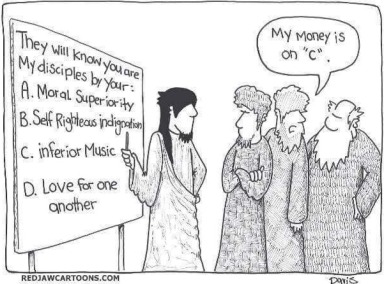
Unfortunately, it’s not our love for one another that often catches people’s attention…
img_0599

The cartoon was sent to me by a friend who doesn’t think very much of some of our contemporary worship music, but it makes a valuable point…self-righteousness and moral superiority are often the things that people notice, especially in the portrayal of Christians by the media (although a lot of us are guilty as charged sometimes, I’m afraid).

The alignment of the religious right with extreme politics in the USA at the present time is probably not helping!

I believe that there is something intensely ‘political’ about being a follower of Jesus, but we miss the point entirely if we simply align ourselves with a political party, whether on the left, right or centre. When Jesus talked about the Kingdom he had something entirely different in mind…those that followed him were to be part of a radical alternative to the kingdoms of the world, with a very different King to Caesar. The Jewish leaders picked it up, as did the Roman authorities. The statement “Jesus is Lord” flew in the face of the expected affirmation that “Caesar is Lord”, with fatal consequences.

And the basic policy of the Kingdom of God is love…love for your brothers and sisters, love for those who don’t know Jesus yet, love for those that everyone else marginalises and excludes, and even love for those who hate and persecute you.

The fact that people can see our love for one another is a sign of the alternative, grace-filled, inclusive Kingdom of God. This kind of community is attractive in a world that is increasingly fractured along lines of age, race, gender, income, employment status, faith and sexuality (to name but a few). Maybe it’s not so attractive to the rich and powerful…

I often hear people preach about and pray for the need for revival.

I strongly believe that when the believers in a place demonstrate that they love one another, that they are part of a Kingdom that embraces all the things that separate and divide them, and that shared faith is more important than denominational tradition and preference, then something powerful happens. The church starts to function as Jesus Body…

It’s then that watching people, hungry for love, acceptance and a spirituality that works, will be drawn to Jesus.

always-watching-cropped

If you want to share this:

  • Email a link to a friend (Opens in new window) Email
  • Print (Opens in new window) Print
  • Share on Reddit (Opens in new window) Reddit
  • More
  • Pocket
  • Share on Threads (Opens in new window) Threads
  • Share on WhatsApp (Opens in new window) WhatsApp
  • Post
Like Loading...

“ONE” – Mixing the ingredients…

Posted by David Ward on 16/10/2016
Posted in: Community, Personal thoughts, Prayer and liturgy, unity, worship. Tagged: Anglican, Baptist, breaking of bead, Brethren, Church, communion, Eucharist, Evangelical Church, God, House Church, Jesus, Justin Martyr, liturgy, Methodist, music, Pocket Testament League, prayer and praise, Roman Catholic, Salvation Army, Scripture Union, The Vineyard, unity, URC, worship, YFC. Leave a comment


worship-variety-copyWhen I was growing up I was part of a ‘used-to-be-Brethren-now-we’re-Free-Evangelical’ church in the south east of England. The youth leaders at that church often took us to experience worship in churches that were different than our own. One of the foundations of the church seemed to be a willingness to work and worship with anyone who loved Jesus, despite having its roots in a movement that’s often known for its isolation and doctrinal purity.

I’ve often wondered what brought such a huge change in attitudes to the men and women in that church. I’ve often wondered if a church that knew its Bible so well (the teaching I received is something I’ll always be grateful for) couldn’t help but do what it says, particularly as it also had an urge that far outweighed its size to share the Good News of Jesus and to bring blessing and encouragement into as many lives as possible.

My family was the result of a marriage between a Roman Catholic (whose Methodist auntie used to take him there as well) and an Anglican. When I was old enough I was sent off to Sunday school at the nearest local church, which happened to be Baptist. When I ‘gave my life to Jesus’ at the ripe old age of 9 during a ‘Beach Mission’ I started to go along with a friend to a youth group that met at the Evangelical church I mentioned above.

In my growing up years I used to be part of a Christian band that played at events in a whole variety of churches, had Roman Catholic friends who sometimes took me to Mass and went to a school with connections to Canterbury Cathedral.

When I got older I was, for a while, an Associate Evangelist with The Pocket Testament League and later an Associate of Scripture Union before joining Youth for Christ as a national staff-worker. I went on to pastor a charismatic-evangelical church in Manchester before pastoring a small, inner-city Baptist Church. I did my theological training alongside folk from the URC, Methodist, Anglican and Baptist churches. Later on I was part of a House church, worshipped with a Vineyard Church and settled very happily into an inner-city Anglican Church in Manchester (where much of my heart still remains).

Since moving to Scotland things have gone full circle…having spent some time in an Evangelical Free church and the Salvation Army, we are currently worshipping with the Baptists again.

So, yes, I’ve changed churches quite a bit and I’ve always had a bias to appreciating the way other Christians do stuff.

All of which leads me to the topic of today’s post…if we are ‘one’ our corporate worship and prayer can be so much richer.

Round about 150 AD a teacher in the church at Rome wrote a letter that we know as ‘The First Apology of Justin the Martyr’. He describes Christian worship at that time:

“And on the day called Sunday, all who live in cities or in the country gather together to one justinplace, and the memoirs of the apostles or the writings of the prophets are read, as long as time permits; then, when the reader has ceased, the president verbally instructs, and exhorts to the imitation of these good things.

Then we all rise together and pray, and, as we before said, when our prayer is ended, bread and wine and water are brought, and the president in like manner offers prayers and thanksgivings, according to his ability, and the people assent, saying Amen; and there is a distribution to each, and a participation of that over which thanks have been given, and to those who are absent a portion is sent by the deacons

And they who are well to do, and willing, give what each thinks fit; and what is collected is deposited with the president, who succours the orphans and widows and those who, through sickness or any other cause, are in want, and those who are in bonds and the strangers sojourning among us, and in a word takes care of all who are in need.”

What is striking here is that if you went into any place of Christian worship today the pattern and the ingredients mentioned in 150 AD would still be recognisably part of the service today.

We still have much in common…the reading of scripture, preaching, prayer, Communion, news and needs still make up the framework for our worship. There is no mention of music or singing, which may not have been wise in a time of persecution, but scripture encourages them too.

What has changed is the way we do them and what we think they are all about…some of us pray extempore prayers, others use carefully crafted liturgy. Some of us like 15 minute homilies, others don’t feel they’ve been fed without at least 45 minutes…maybe longer. Some of us like our services to be quiet and contemplative, others like loud and enthusiastic worship music. Some churches have organs and choirs, others have bands and worship leaders and some only sing unaccompanied Psalms. Some of us use all manner of modern multi-media and some of us prefer words and books. Some believe that the bread and wine is just a symbol, others attach more significance to its substance…what matters is that Jesus told us to do it! (And it’s possibly the only firm instruction for our gatherings together that he left.)

When each of us comes to worship we have at our disposal a tremendous arsenal of ways to pray and praise. They enable our God-given preferences and temperaments to focus, rather than distract us, from the object of our worship. And when God is wholeheartedly worshipped we often come away feeling refreshed and encouraged ourselves too.

I am so grateful for the richer experience of worship that has come from an appreciation of the unity and diversity of the church.

worship


If you want to share this:

  • Email a link to a friend (Opens in new window) Email
  • Print (Opens in new window) Print
  • Share on Reddit (Opens in new window) Reddit
  • More
  • Pocket
  • Share on Threads (Opens in new window) Threads
  • Share on WhatsApp (Opens in new window) WhatsApp
  • Post
Like Loading...

“ONE” – Unity, Liberty and Charity…

Posted by David Ward on 13/10/2016
Posted in: Community, Personal thoughts, Relationships, unity. Tagged: Apostles Creed, Augustine of Hippo, charoity, Creeds, disciple student, experience, Holy Spirit, humility, Jesus, liberty, Methodist Covenant service, Nicene Crede, Peter Enns "The Sin of Cerainty", reason, scripture, tradition, unity, Wesleyan Quadrilateral. Leave a comment

“In essentials, unity; in non-essentials, liberty; in all things, charity.”

Augustine of Hippo

I’m certain you will probably be familiar with Augustine’s much-quoted words…but how do they work out in practice?

Can we reach some agreement over what are the essential and non-essential features of the gospel, devoid of our upbringing and our cultural and denominational preferences?

Is it really possible to have a fundamentally different set of interpretations and practices and still demonstrate our overwhelming love for each other, showing that we “in humility value others above ourselves” (Philippians 2: 3)?

What is certain is that as we strive to understand and appreciate the differences in emphasis, interpretation and practice of others we not only increase our understanding of the ways of God, but we also grow in humility and avoid what one writer refers to as “the sin of certainty” (Peter Enns in the book of the same name).

If only we could put as much effort into finding the things that bind us together as we all too often spend finding ways to exclude and marginalise.

What follows is a brief survey of some of the things I’ve found helpful.

So, how do we come to ‘know’ what we know about God? The Methodist Church developed a helpful model for theological reflection (often referred to as the Wesleyan Quadrilateral)

wesleyan-quadrilateral

For most Christians, scripture is the prime source. However, few of us come to scripture unencumbered by the interpretive baggage of our denominational tradition and our personal experience of God, so perhaps scripture is not as definitive as we sometimes like to believe. Today, as the discipline of Biblical studies continues to throw light on the ancient texts in their cultural context, we can see that many of our cherished evangelical interpretations owe more to the reformers and the revivalists than to the early church…it is a minefield. Reason asks, “Can this doctrine be defended? Does it fit with the other things we know about God?”

We believe that the Holy Spirit is the “Spirit of truth”, who “will teach you all things and will remind you of everything that I have said to you” (Jesus in John 14). Perhaps the truth is much broader and complete if seen through the eyes of many believers, as the Holy Spirit uses scripture, tradition, experience and reason to open our eyes to the greatness of God and the things he does.

apostles-creedThe historic Creeds of the church, especially the Apostles Creed and the Nicene Creed may be helpful in determining what the early church saw as being the fundamentals of faith. Mostly they focus on the person and work of Jesus, which forms the bulk of both Creeds. Although a Creed is not an exhaustive statement of faith, I was slightly surprised by things that we focus on that don’t appear, or have only passing references.

It seems to me that who we trust and follow is much more important than what we currently believe. Perhaps our ‘non-negotiables’ should be a much shorter list than we often uphold?

I have to constantly remind myself that, in Biblical terms, I am a disciple, a student who still has much to learn from the Teacher…indeed the longer I have been a follower of Jesus, the more conscious I have been of my need to go on learning. And as a learner, grace, mercy and humility should be my constant companions.

A number of years ago I was one of the ministers of a large evangelical charismatic church in Manchester. The congregation which I led started to build relationships with the local Council of Churches. Some of our members felt that we had more to lose than to gain through this relationship, as we had little to learn from the other denominations.

I was especially friendly with the local Methodist minister, who invited us to join their church for their annual Covenant Service. Knowing that some of our members would struggle he invited me to preach at the service. So I announced that we would be closing down our church on that Sunday and all worshipping with the Methodists.

One of my younger leaders, let’s call him Wayne, was particularly antagonistic to the idea of the joint service. He really struggled with meeting with people who didn’t have their faith together like we did…

I don’t know if you’re familiar with the Methodist Covenant service, but they key part of the service is when all stand together and commit themselves before God to live their lives in Covenant with him, by praying the Covenant Prayer.

The prayer says:

‘I am no longer my own but yours.
Put me to what you will, rank me with whom you will;
put me to doing, put me to suffering;
let me be employed for you, or laid aside for you,
exalted for you, or brought low for you;
let me be full, let me be empty,
let me have all things, let me have nothing:
I freely and wholeheartedly yield all things
to your pleasure and disposal.
And now, glorious and blessed God,
Father, Son and Holy Spirit,
you are mine and I am yours. So be it.
And the covenant now made on earth, let it be ratified in heaven.’

After the service an obviously moved and chastened Wayne came to me.

“I hadn’t realised,” he said, “just how dedicated these Methodists are. That prayer…I really struggled to pray it myself.”

I think that for him it was a moment every bit as significant as the vision of the Apostle Paul on the roof at the home of Simon the Tanner…perhaps we all need such a moment to open our eyes to the ‘wideness of God’s mercy”.

comprehensive

If you want to share this:

  • Email a link to a friend (Opens in new window) Email
  • Print (Opens in new window) Print
  • Share on Reddit (Opens in new window) Reddit
  • More
  • Pocket
  • Share on Threads (Opens in new window) Threads
  • Share on WhatsApp (Opens in new window) WhatsApp
  • Post
Like Loading...

Posts navigation

← Older Entries
Newer Entries →
  • Recent Posts

    • Missing the Point(er)… 22/12/2025
    • A review of “Domestic Monastery” by Ronald Rolheiser 08/08/2025
    • A review of “Faith Habits and how to form them by Emma Timms 23/07/2025
  • Archives

  • Blogs I follow

    • Downtown Monks
    • Far From Home
    • Northumbrian Collective
Website Built with WordPress.com.
Pilgrim Traveller
Website Built with WordPress.com.
  • Subscribe Subscribed
    • Pilgrim Traveller
    • Join 105 other subscribers
    • Already have a WordPress.com account? Log in now.
    • Pilgrim Traveller
    • Subscribe Subscribed
    • Sign up
    • Log in
    • Report this content
    • View site in Reader
    • Manage subscriptions
    • Collapse this bar
 

Loading Comments...
 

    %d