Pilgrim Traveller

thoughts on life’s journey…

  • About

Apprentices of Jesus…

Posted by David Ward on 08/04/2024
Posted in: Books/Articles, discipleship, Spititual Practices. Tagged: discipleship, Faith, Jesus, John Mark Comer, new Christian, practicing the way, Rule of Life, spiritual practices, transformation. Leave a comment

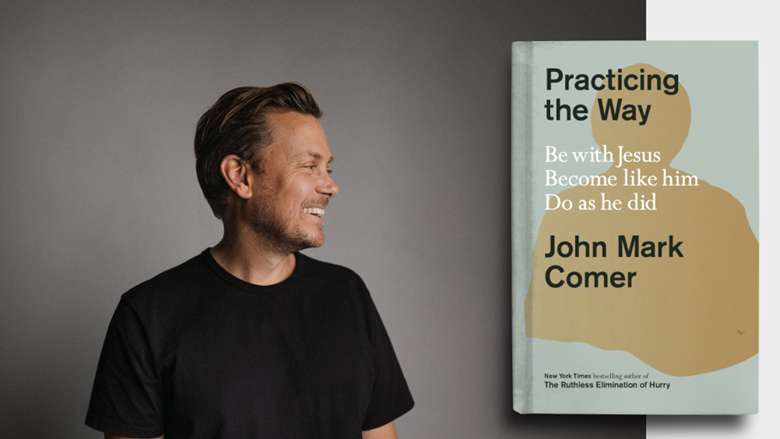
A brief review of “Practicing the Way…be with Jesus, become like him, do as he did” by John Mark Comer.

This book builds on some of the ideas introduced in John Mark’s previous book, “The Ruthless Elimination of Hurry”.

It focuses on three questions:

  • Who or what are you following?
  • Who or what are you becoming?
  • Who or what are you entrusting your life to?

The fact is, we’re all building our lives on someone or something, it’s an inevitable part of being human. There are people or philosophies of life we admire and seek to emulate; it’s not just religious people. And it follows that as people we are becoming like the people or things we admire…they affect our thinking, our behaviour and our relationships. In fact, every part of our lives.

In the world of the New Testament, such a person in Jewish culture would be called a rabbi (teacher). Jesus was a rabbi, who went around saying, “Come, follow me.” (Matthew 4:19). But what does that mean? John Mark Comer writes:

“Contrary to what many assume, Jesus did not invite people to convert to Christianity. He didn’t even call people to become Christians (keep reading…); he invited people to apprentice (disciple) under him into a whole new way of living. To be transformed.”

“Practicing the Way” p xvi

The rest of the book investigates how Jesus did this and suggests three “Goals” to pursue so we can be transformed into Jesus image by being with him, becoming like him and doing what he did.

The final bit of the book looks at the practical ways we can pursue the three goals, focussing on a having a Rule of Life lived out through nine spiritual practices that Jesus followed in his life.

A number of my friends found John Mark Comer’s “The Ruthless Elimination of Hurry” to be “a bit legalistic”, and I dare say might level the same criticism at this book.

However, it’s important to note that the close relationship to Jesus is key. Without it copying the things that Jesus said and did will not really change us one bit and is in danger of becoming a box-ticking kind of legalism.

I found this to be a most helpful book, and one I would not hesitate to recommend to new followers of Jesus or those mentoring them. There is even a helpful online course for groups (it might be possible to use as an individual too); you can find it here: https://www.practicingtheway.org/course .

If you want to share this:

  • Email a link to a friend (Opens in new window) Email
  • Print (Opens in new window) Print
  • Share on Reddit (Opens in new window) Reddit
  • More
  • Pocket
  • Share on Threads (Opens in new window) Threads
  • Share on WhatsApp (Opens in new window) WhatsApp
  • Post
Like Loading...

Jesus goes to ‘church’…

Posted by David Ward on 28/03/2024
Posted in: Bible, Personal thoughts. Tagged: Church, discomfort, disruption, Holy Week, Jesus, prophecy, synagogue, Temple, transformation. Leave a comment

I was reading a book about worship which talked about how we often invite Jesus to be present at our worship, taking him up on his promise in Matthew 18:20 (NIrV) “Where two or three people gather in my name, I am there with them.”

I got to thinking about times in the New Testament when we read about Jesus going to church – of course, I know the church hadn’t started then, but looked at times Jesus went to the Jewish equivalents, the Temple or the synagogue. I had a hunch that if Jesus turned up to our church meetings in the same way he is recorded on his visits to the Temple or synagogue, we might be a little more cautious about asking him to come and meet with us.

Jesus must have visited the Temple or synagogue quite a few times during his lifetime, but the Gospels record only four visits to the synagogue and 10 to the Temple. So, I have to ask what’s the significance, if any, of this handful that have been recorded?

A reading of the Gospels suggests three things:

  • In the gospel accounts Jesus’ harshest words are often reserved for religious people, especially their leaders.
  • In stark contrast, it’s often the people who least expect it, the lost, the least and the last that are helped, healed, commended and blessed by Jesus.
  • Jesus seems rarely to have visited ‘church’ without causing trouble or controversy.

I’m writing this in Holy Week, so a dramatic occasion when Jesus visited the Temple comes instantly to mind…that visit where he turned over a few tables and chased a bunch of traders out.

What got to him on this occasion? Was it that people failed to recognise “sacred space”? Did it have to do with the exploitation of worshippers by cheating traders and unscrupulous religious leaders?

Maybe most of all it was because they’d set up their market stalls in the part of the Temple courts where non-Jews were allowed to pray. So, a group of people who were discriminated against by the purity laws in Herod’s Temple were denied access to the one area where they could worship Yahweh…hence Jesus words, “Is it not written: ‘My house will be called a house of prayer for all nations’? But you have made it ‘a den of robbers.'” Mark 11:17 NIV (quoting Jeremiah 7:11).

I wonder, what tables would Jesus overturn in our churches? Would he be critical of our failures to be truly inclusive, our tendency to welcome only people like us and the tick-box mentality we apply to decide if people are in or out and theologically ‘sound’?

Here’s a few more things that might happen if Jesus came to our church:

  • Only a few people might recognise him, including the people who should know him the best (eg Luke 4:14 to 30).
  • Impure spirits won’t be able to hide from him (yes, impure spirits, even in church) (eg Luke 4:31 to 37).
  • People will be divided over his identity and authority (Luke 4: 16 to 30; Luke 20:1 to 8; John 7:25 to 52).
  • He might argue and debate with the leadership, tell pointed stories about them or preach sermons that would make people want to arrest him (Luke 20:9 to 38).
  • He might heal someone at an awkward time (Luke 6:6 to 11; Luke 13:10 to 17).
  • He might question our motives for giving (Luke 21:1 to 4; Mark 12:41 to 44).

So, a visit from Jesus might be messy and disruptive, and not the cosy, encouraging time that we hope for. That’s why gifts like prophecy are difficult to manage in our services. But for those who have open hands and hearts it might be just the time we need, a time when we become more aware of the bits of us that still don’t resemble Jesus very much, repent and receive the help of the Holy Spirit to transform them. That’s both for us as individuals and as a Christian community.

Come to think of it, when we’re together for worship Jesus always turns up. He’s full of grace and meets with us just as we are, but sometimes he loves us so much that he’s keen that we don’t stay as we are and says difficult things to us to make us aware of our need for change and our need of him. He loves us far too much to see things in our lives that stop us becoming more like him and not do anything about it.

It might be uncomfortable sometimes, but I’ll go on praying that Jesus is present when we gather for worship.

If you want to share this:

  • Email a link to a friend (Opens in new window) Email
  • Print (Opens in new window) Print
  • Share on Reddit (Opens in new window) Reddit
  • More
  • Pocket
  • Share on Threads (Opens in new window) Threads
  • Share on WhatsApp (Opens in new window) WhatsApp
  • Post
Like Loading...

We Fly Away…

Posted by David Ward on 20/03/2024
Posted in: Bible, discipleship, Personal thoughts, Spirituality. Tagged: aging, best years of life, Bible, Psalms, spiritual formation. Leave a comment

Sometimes, the things I’m reading seem to flow together to give a coherent message. This post is the result of a coming together of scripture, social studies and a couple of books by Christian authors. It also speaks to the particular stage of life I’m in at present.

“Seventy years are given to us!
Some even live to eighty.
But even the best years are filled with pain and trouble;
soon they disappear, and we fly away.”

Psalm 90:10 NLT

That’s the long and the short of it – human existence is brief and fragile. God is eternal and glorious. Yet if we live this transient life in close relationship with God we can enjoy our best years despite the pain and trouble.

I’ve read a number of studies that reckon that our thirties are the “best” years of life. However, more recently there appears to be a shift among secular writers to suggest that our post-sixty years may well be our best. It may be that we care less about what people think about us or that we don’t feel we need to “play the game” to fit in any more. Perhaps for that reason we’re able to take on things freed from the fear of failing and looking foolish. Perhaps life experience brings wisdom about what really matter enabling us to make choices that bring joy to ourselves and others.

All this goes against the negative depiction of aging prevalent in much of the media, of aches and pains, of loss, of the gradual shrinking of our world . Yet through these times, even despite these times older people enjoy a carefree enjoyment of life where we can be ourselves and no longer fear the cares of life or the descent into dependency.

But what does this mean to us as followers of Jesus? In one study I read people who were most energised and joyous were those who gave their time and energy to serving and helping others. Surely after a life time of following Jesus we could be people who know how to do this.

In his book “Practicing the Way”, John Mark Comer writes:

…The spiritual teacher Pete Scazzero once told me a maxim that was passed on to him by an older, wiser mentor: “The best decade of your life will be your seventies, the second best will be your eighties, and the third will be your sixties.” By best he did not mean the happiest (though I expect that too) but our richest and most joyful and helpful to others.

John Mark Comer, “Practising the Way”

John Mark writes this in the context of spiritual formation, of becoming more and more like Jesus. He says that becoming like Jesus is a life-long process, as we get to know him better and to rely on his Spirit more and more. It is more than “a little tune up on the way to the afterlife”. For too long we have misunderstood eternal life as being something we long for as we crawl through this life until at last we die and go to heaven. We have failed to see that Jesus invites us to begin living his kind of life right now as we spend time with him, become like him and do what he did. John Mark says:

“…we cannot lower the horizon of possibility that was set by the extraordinary life of Jesus and gift of his Spirit. Instead, we must stay with the process for as long as it takes to actualize our destinies.

And this may take a very long time.

…It’s more like a quiet undercurrent that slowly accumulates at the base of your soul, increasingly welling up like a soft melody that over the years becomes the soundtrack of your life”

John Mark Comer, “Practising the Way”

It’s probably no coincidence that several prominent Bible characters were well past the first flush of youth before God called them to do significant things. Abraham was about 74, Moses 80 and Caleb 85 –

“Now, as you can see, the LORD has kept me alive and well as he promised for all these forty-five years since Moses made this promise-even while Israel wandered in the wilderness. Today I am eighty-five years old. [11] I am as strong now as I was when Moses sent me on that journey, and I can still travel and fight as well as I could then. [12] So give me the hill country that the LORD promised me.

Joshua 14:10-12 NLT

I forgot to mention that I am approaching my 72nd birthday. I guess that means I should get ready to “fly away”. But I think that taking flight means so much more than just going to heaven. Until that day I still need to spread my wings and ride the wind of the Holy Spirit wherever he takes me. My 50s and 60s have been eventful, sometimes tough but definitely joyful when I’ve kept close to Jesus. And I’m looking forward to the things God still Has for me to do and the life he wants me to live going forward. As Christine Caine says:

The kind of spirit Caleb has is the kind of spirit I always want to have, don’t you? One that says, “I’m eighty-five and God isn’t finished with me yet”. One that says, “There are still Kingdom assignments to fulfil, and I want a piece of the action. I am still enduring in faith and, until I draw my last breath, I won’t be done.”

Christine Caine, “You’re Not Finished Yet”

Becoming like that is a life long process of becoming more like Jesus, starting when he first calls us to follow him. Now would be a good time to begin!

If you want to share this:

  • Email a link to a friend (Opens in new window) Email
  • Print (Opens in new window) Print
  • Share on Reddit (Opens in new window) Reddit
  • More
  • Pocket
  • Share on Threads (Opens in new window) Threads
  • Share on WhatsApp (Opens in new window) WhatsApp
  • Post
Like Loading...

Posts navigation

← Older Entries
Newer Entries →
  • Recent Posts

    • Missing the Point(er)… 22/12/2025
    • A review of “Domestic Monastery” by Ronald Rolheiser 08/08/2025
    • A review of “Faith Habits and how to form them by Emma Timms 23/07/2025
  • Archives

  • Blogs I follow

    • Downtown Monks
    • Far From Home
    • Northumbrian Collective
Website Built with WordPress.com.
Pilgrim Traveller
Website Built with WordPress.com.
  • Subscribe Subscribed
    • Pilgrim Traveller
    • Join 105 other subscribers
    • Already have a WordPress.com account? Log in now.
    • Pilgrim Traveller
    • Subscribe Subscribed
    • Sign up
    • Log in
    • Report this content
    • View site in Reader
    • Manage subscriptions
    • Collapse this bar
 

Loading Comments...
 

    %d