Pilgrim Traveller

thoughts on life’s journey…

  • About

Making Waves…

Posted by David Ward on 17/03/2024
Posted in: Bible, church, Mental Health, Personal thoughts. Tagged: "See Me" Scotland, Bible, Church, depression, discrimination, Faith, hope, Jesus, Mental Health, prejudice, Psalm 42/43, Psalms, stigma. Leave a comment

We turned up to our regular beach to walk the other day but found there was no beach to walk the dog on. We knew it was near high tide time but had failed to register that we were close to the Spring equinox. We haven’t lived in the area for long, so we’d never seen just how high a Spring tide could be on this coast. We opted for a walk in the dunes instead.

On Sunday we drove into a nearby small town. Our church meets in a building close to the sea, and as we walked there, we were treated to not only the sight of a really high tide, but on a still, almost windless day the rocks, the breakwater and the beach was being pounded by some enormous waves in a sea that boiled and crashed in a most intimidating way. I was glad to be on dry land and prayed there’d be no call out for the local lifeboat crew.

During the service we sat near the window with a grandstand view of the sea in all its fury and glory. It was a fitting reminder of God’s power and glory, in the words of C S Lewis, “of course he isn’t safe, but he’s good”. (The Lion, the Witch and the Wardrobe).

Those waves made me think of some words from a familiar psalm:

I hear the tumult of the raging seas as your waves and surging tides sweep over me.
But each day the LORD pours his unfailing love upon me,
and through each night I sing his songs, praying to God who gives me life.

Psalm 42:7-8 NLT

I’ve always identified with these words and found them to be deeply encouraging.
Many commentators believe that this is a psalm (and Psalms 42 and 43 seem to actually be one extended psalm) about depression, after all a song is a great way to express just how you feel. This song reminds us that even in deep depression we can bring how we feel into God’s presence, without fear that he will be embarrassed or turn us away.

It’s a song of lament that asks the question , “Why, God?” –  Why do I feel this way? Why do you seem to be so far away? Why do I feel so downcast and disturbed? Why have you forgotten me? Why are you allowing people to taunt me? Why have you rejected me? When will this end? It’s a song about the tension between faith and circumstances, a song that tries to understand why God “allows” us to suffer.

In this instant this depression is affecting the individuals ability to find joy in worship, which must have been doubly difficult for one of the sons of Korah, a member of the Levitical choir in the Temple…think Worship Leader! The fact is that “True believers do go through times of deep emotional suffering. They need our loving prayer and support, not our criticism and suspicion” Alan Palmer in “Discovering Psalms 1-72.

I am one such believer, suffering from depression at a number of times in my life. A number of years ago my wife, who is a qualified mental health therapist, put together a booklet which was sponsored by the charity “See Me” in Scotland. The booklet was  a collection of stories from people with lived experience of mental health. I contributed a piece sadly written from my own perspective as a Christian in leadership.

“The man was depressed, really clinically depressed.
The church of which he was part could not cope with depression. He was dropped from the leadership and from teaching in the church without discussion. One of the senior leaders from the church came to visit.

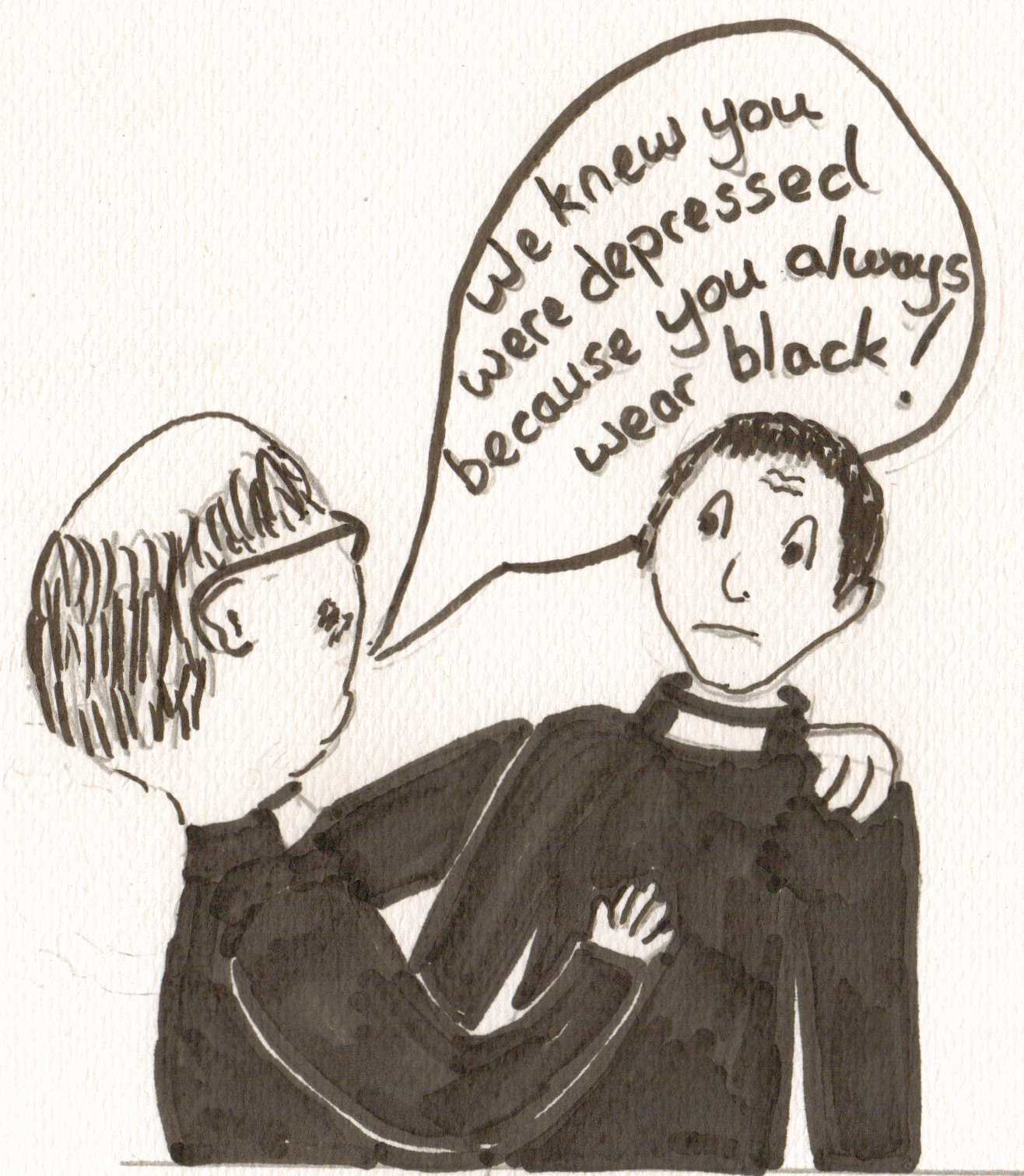
“Of course,” he said seriously, “we could tell just by looking that you had a problem. We knew something was wrong in your life.” He paused.

“It’s the fact that you always wear black,” he said, without even the hint of a smile, “and that means you must be depressed (and in the leader’s view, depressed people are second-class Christians).

Years later he’s reading a frequented blog. There is a discussion about the wearing of black. The blogger posts…“Sometimes I wear grey to show my unbridled joy!”

The man, who has long since recovered, laughs out loud remembering the absurdity of the leader whose outlook was so “black”. But he is grieved at the ignorance and misunderstanding experienced by those suffering with mental illness, and he is angry at the church leader’s lack of resemblance to the One he claimed to follow.”

“Please Remove the Label”, compiled and edited by Wendy Ward
When we are depressed, when we are struggling to make sense of our lives and asking why God has allowed us to get to this state, the last thing we need is to be told that we are less than acceptable to the church and therefore, by extension, to God. It is at these times that we need every encouragement to continue to be people who have hope because they have Jesus; we need help to continue to stay close to him as we work through our questions.

If we look closely at the psalm we can learn a lot about how this son of Korah had become depressed and how he was working it through. He seems to experience six stages as he goes through his time of depression:

  • Separation 42:4 and 42:6. He was probably geographically away from the Temple and Jerusalem, and it was a painful place to be. To put it more generally, sometimes we’re just not in the place we want to be, whether that’s geographical, vocational or emotional.
  • Attack 42:3 and 42:9-10. He was being attacked, both for his lack of faith and for continuing to have faith when his circumstances were so dire. People who criticise, even Christians who criticise, can have such double standards.
  • Grief 42:3, 42:5, 42:7 and 43:2. He expresses an overwhelming sense of loss. Loss of companionship, loss of worship, loss of relationship with God. His heart is sick and broken.

However, even while he still struggles to feel ‘right’ again, his continuing faith propels him to co-operate with God’s spirit in the work of recovery, healing and restoration.

  • Survival 42:1-2. Like a deer in the desert seeking out water, the source of life, the man is longing for God, for the spiritual refreshment and life that comes from his presence. Even though he is struggling to find God in his circumstances he hasn’t stopped looking!
  • Cure 42:4, 42:5, 42:11 and 43:3. The man doesn’t just wait passively for God to sort him out, he has a strategy for recovery. He looks back, and remembers all that God has done in the past and looks forward expectantly to God doing it again…”I will yet praise him” (42:5 and 11; 43:5
  • Recovery 43:4-5. Above all, the man has not lost hope – “Put your hope in God” is his constant refrain.

The NIV translation of 42:7 is “Deep calls to deep in the roar of your waterfalls; all your waves and breakers have swept over me.” I have often wondered if the first part of the verse speaks of the discovery of God’s Spirit in the spirit of the man, a deep relationship that is not broken and offers hope even as “the waves and breakers have swept over” him.

Even in our times of darkest depression the Spirit of God calls out to us in the depths of our being that we are loved by God and there is hope – “ send me your light and your faithful care, let them lead me to your holy mountain, to the place where you dwell” 43:3.

If you want to share this:

  • Email a link to a friend (Opens in new window) Email
  • Print (Opens in new window) Print
  • Share on Reddit (Opens in new window) Reddit
  • More
  • Pocket
  • Share on Threads (Opens in new window) Threads
  • Share on WhatsApp (Opens in new window) WhatsApp
  • Post
Like Loading...

Twists and Turns of Life…

Posted by David Ward on 15/03/2024
Posted in: Bible, discipleship, Personal thoughts. Tagged: Bible, Celtic Daily Prayer, Christianity, comfort, Faith, God, Jesus, John Mark Comer, loss, Northumbria Community, Psalm 71, restoration, spiritual formation, St Brendan, troubles, uncertainty. Leave a comment

We’ve recently had to leave our home of 14 years in the Scottish Borders and after a period of “spare room surfing” with friends and family we’ve moved 60-odd miles south, back into England. We’ve been homeless before, back in the early days of our marriage. Following the collapse of a couple of jobs we simply couldn’t afford to pay the bills anymore, and for a while lived with another family from our church, while we recovered financially and were able to get back to more stable work and income.

Both experiences carried with them a significant sense of loss and uncertainty as we went through those times of transition.

I guess you may be thinking “that’s just how life plays out sometimes”, we all have our ups and downs, and even for those of us who follow Jesus, life often twists and turns in unexpected ways.

I was thinking about all this recently, and smiled when I remembered an incident that happened many years ago, when I was a young teenager. I was at a youth group meeting where we were asked to share a favourite verse from the Bible, something that meant a lot to us. For some reason I didn’t have a verse to share, so I’m ashamed to say I opened my Bible randomly and read the first verse my eyes focussed on. I hasten to say that I do not recommend this method of choosing a significant verse, let alone employing this ‘open and point’ method to get some guidance from God. The verse I had randomly chosen was:

“You have allowed me to suffer much hardship, but you will restore me to life again and lift me up from the depths of the earth. You will restore me to even greater honour and comfort me once again.

Psalm 71:20-21 NLT

Could be the story of my life! As I reflected on my past, I thought about the hardships I have suffered (although they pale into insignificance compared to the things that many people have to suffer). Betrayals in work, in church and in relationships all leave nasty scars. Two lots of homelessness, divorce…actually make that three lots of homelessness…being separated from my children…the list goes on.

And as I was reminded recently when reading John Mark Comer’s excellent book “Practicing the Way”, all these events have a part to play in our formation, in making us the kind of people we are. As John Mark says, “Spiritual formation isn’t a Christian thing; it’s a human thing”.

He goes on to say:

“Spiritual formation is not optional. Every thought you think, every emotion you let shape your behaviour, every attitude you let rest in your body, every decision you make, each word you speak, every relationship you enter into, the habits that make up your days, whether or not you have social media (if you do, how you use it),how you respond to pain and suffering, how you handle failure or success-all these things and more are forming us into a particular shape…We are being either transformed into the love and beauty of Jesus or malformed by the entropy of sin and death.”

John Mark Comer, “Practicing the Way”

Wow! If we thought spiritual formation was all about adopting some ancient spiritual disciplines (good as that is!) we need to think again.

Which brings me back to that verse from Psalm 71. The psalmist has confidence that God has a major part to play in his “spiritual formation”, a God who is faithful, a God who will lift him up, comfort him and restore his life, the life he thought he had lost.

And I want to echo that. However tough these times of ‘hardship’ and change have been, we have always come through them transformed and restored. At least, we have when we’ve chosen not to dwell on the pain from the past and co-operate with God’s Spirit in the renewing process. I can’t pretend that I’ve always got it right, but when I have, God is faithful. And sometimes, even when I’ve got it wrong God has changed things for our good, because God is also full of grace! Some time ago a friend who has witnessed some of these life events commented that she’d always been impressed by the way I “re-invented” myself…I know what she means although I might prefer to say that I went along with God in his process of changing me.

The Northumbria Community has a wonderful liturgy dedicated to St Brendan, a saint who followed the prompting of God and ventured into the unknown. Towards the end, we find these words:

“I choose to live beyond regret, and let You recreate my life.
I believe You will make a way for me and provide for me,
if only I trust You and obey.
I will trust in the darkness and know that my times are still in Your hand.
I will believe You for my future, chapter by chapter, until all the story is written.”

Brendan – in exploration of a vision from Celtic Daily Prayer Book One

I hear echoes of those verses from Psalm 71 in these words, but they take it a bit further. God’s promises should not induce in us some kind of passive belief. Faith is about action born out of trusting what God says. It’s about moving forward hopefully. It’s about focussing our eyes on the possibilities and stepping through opening doors. It’s about being changed to be more like Jesus.


If you want to share this:

  • Email a link to a friend (Opens in new window) Email
  • Print (Opens in new window) Print
  • Share on Reddit (Opens in new window) Reddit
  • More
  • Pocket
  • Share on Threads (Opens in new window) Threads
  • Share on WhatsApp (Opens in new window) WhatsApp
  • Post
Like Loading...

Power and Warmth…

Posted by David Ward on 30/03/2023
Posted in: Books/Articles, church, Community, discipleship, Personal thoughts. Tagged: current culture, discipleship, holiness, Holy Spirit, lighting beacons, post-Covid world, renewal, revival, the church. Leave a comment

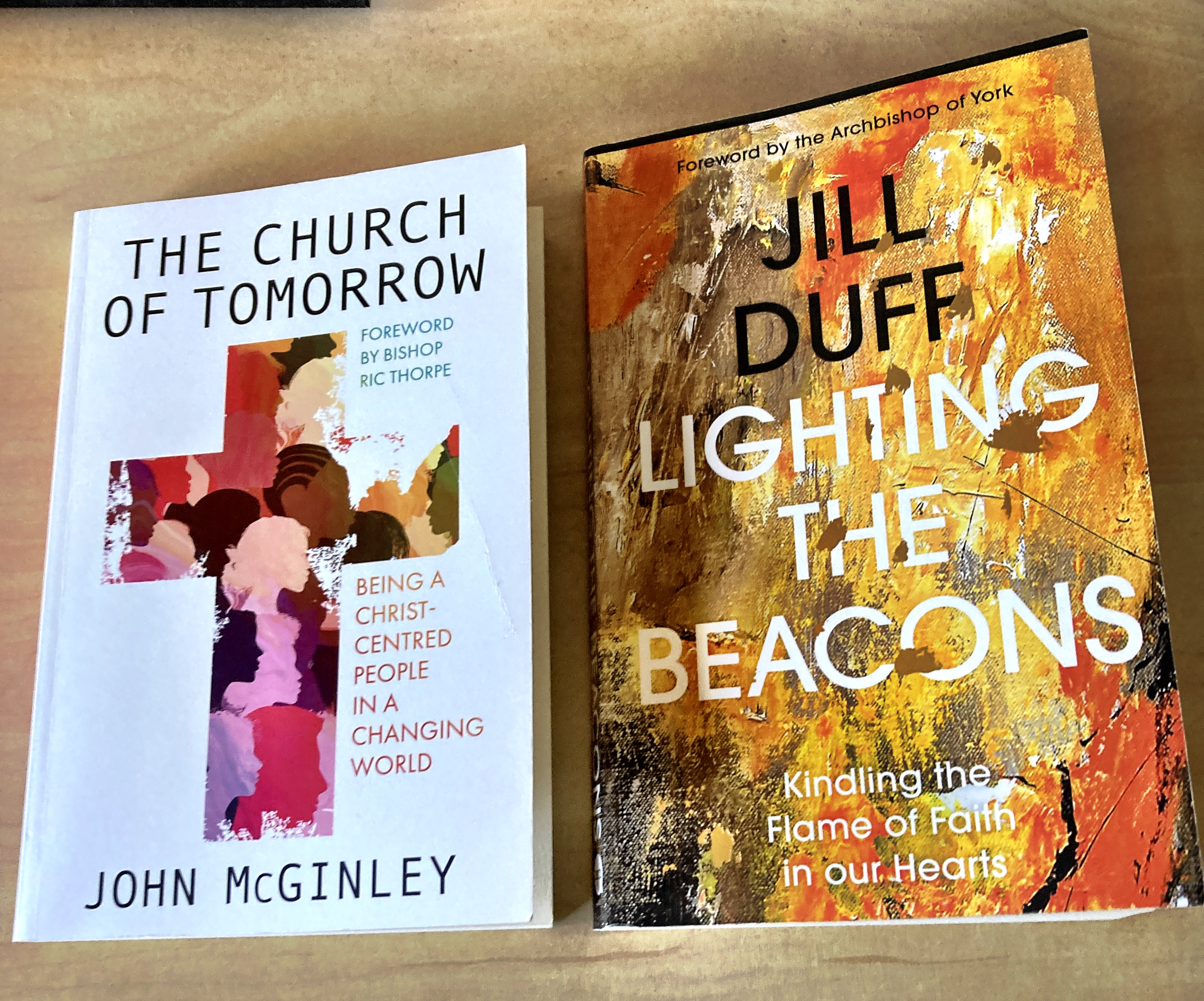
A review of “The Church of Tomorrow” by John McGinley and “Lighting the Beacons” by Jill Duff.

One of Aesop’s Fables tells the story of a competition between the Wind and the Sun. The challenge is to make a man remove his cloak. The two competitors go about it in totally different ways. The Wind blows harder and harder, but simply causes the man to wrap the cloak even more tightly around him. The Sun, on the other hand, simply shines more and more brightly upon the man, until he is so warm that he sheds the cloak.

I have been reading two books, both with the same end in view, but written in very different ways to achieve their objective…the renewal of faith in a church appropriate and fit for the post-Covid world. Both McGinley and Duff are Anglicans and associated with New Wine. McGinley is a church planter and builder of missional communities, whilst Duff is a Bishop, working in Lancashire and St Asaph, Wales, and was formerly a founding director and lecturer at the ministry training college of St Mellitus North West. They have much in common.

Their approaches are, however, quite different, with McGinley focussing on “Power” and Duff on “Warmth”. Both point to a renewed dependence on the Holy Spirit (who is described in scripture as both wind and fire) and a return to our first love for Jesus (Revelation 2: 4).

McGinley’s approach is more analytical. He begins by reminding readers that every 500 years the church seems to go through a period of change, often brought about by a combination of factors in our cultures…external crisis + inner conviction + God-given momentum = church reformation. He looks at each of these in detail, then goes on to examine eight landmark practices that will characterise the changing church, devoting a chapter to each.

He finishes by saying:

“This book has been an invitation to hold the plumb line of Scripture, the Church in revival in history and the rapidly growing Church around the world up against the Church that you and I belong to in the West and to note the differences.”

Duff’s approach is much more narrative, flowing from her apparent hands-on style as a bishop in the C of E. She examines much of the cause and effect of decline and renewal that John McGinley does.

Her first chapter, which sets out the heart of the book, is summed up by:

“The fire in God’s heart, which lights the beacons, is all about sending this message, ‘We miss you, please come home’”

She examines the work of the Spirit in the life of believers, key people in lighting the beacons, fanning the sparks of the Spirit into flame, things that might quench the flame (a powerful chapter) looks at the battle we’re in and looks forward hopefully to a renewed and revived church.

She uses images from Tolkien’s “The Return of the King” to introduce the biblical themes and illustrates the themes and practices with stories about real people living for Jesus in the here and now.

“My hope is that each of us, warmed by fresh fire of the Spirit, finds new faith to see visions and courage to dare to dream dreams. Dreams of the heavenly version of the places where we live, the spheres of influence in which we find ourselves, the communities we belong to, the countries we love…And then with gutsy courage and determined faith we offered our lives unreservedly  to be God’s junior partners, fired by all his ‘incomparably great power for us who believe’ (Ephesians 1: 19), to see that heavenly blueprint begin to break in as a reality while we are still alive”

John McGinley came across as a bit stern and left me with a sense of a steep hill to climb and more than a little guilt/conviction (probably a good thing), while Jill Duff is warmer and more personal, and produced in me a real sense of the powerful love of Jesus and the response of “I can do that”.

Both books are worthy of serious consideration as they will unquestionably impact people of different temperaments, and both contain much to convict, teach and encourage us as we are becoming the Church of tomorrow.

If you want to share this:

  • Email a link to a friend (Opens in new window) Email
  • Print (Opens in new window) Print
  • Share on Reddit (Opens in new window) Reddit
  • More
  • Pocket
  • Share on Threads (Opens in new window) Threads
  • Share on WhatsApp (Opens in new window) WhatsApp
  • Post
Like Loading...

Posts navigation

← Older Entries
Newer Entries →
  • Recent Posts

    • Missing the Point(er)… 22/12/2025
    • A review of “Domestic Monastery” by Ronald Rolheiser 08/08/2025
    • A review of “Faith Habits and how to form them by Emma Timms 23/07/2025
  • Archives

  • Blogs I follow

    • Downtown Monks
    • Far From Home
    • Northumbrian Collective
Website Built with WordPress.com.
Pilgrim Traveller
Website Built with WordPress.com.
  • Subscribe Subscribed
    • Pilgrim Traveller
    • Join 105 other subscribers
    • Already have a WordPress.com account? Log in now.
    • Pilgrim Traveller
    • Subscribe Subscribed
    • Sign up
    • Log in
    • Report this content
    • View site in Reader
    • Manage subscriptions
    • Collapse this bar
 

Loading Comments...
 

    %d