
 You may remember that some time ago I wrote a series around the theme of “Life as Pilgrimage”,which continues here.
Hence my interest in the title and theme of this book: “Journey – he way of the disciple”, by Richard Littlejohn. Richard is a Baptist minister in Newbury, Berks. and has tried to compare discipleship to the stages on a pilgrimage.
The book gets off to a bit of a slow start, but quickly gathers speed as the print pilgrimage takes us through the stages of leaving, finding provisions for the journey, our relationships with companions on the way, distractions, arriving at our goal and the return to ‘normality’.
I think the highlight of the book for me was chapter 7, “Journey’s End”, which is a sensitive and powerful piece about death and bereavement.
All in all, a very thoughtful book, peppered with quotes from other ‘pilgrim’ literature and a range of ‘walking’ literature which firmly embed it in the real world.
Definitely worth a read!
bereavement
All posts tagged bereavement

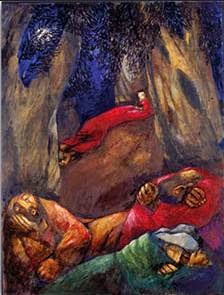
Praying…weeping…pleading.
[41] He pulled away from them about a stone’s throw, knelt down, and prayed, [42] “Father, remove this cup from me. But please, not what I want. What do you want?” [43] At once an angel from heaven was at his side, strengthening him. [44] He prayed on all the harder. Sweat, wrung from him like drops of blood, poured off his face.
Luke 22:41-44 (MSG)
Watching…waiting…sleeping.
[45] When he rose from prayer and went back to the disciples, he found them asleep, exhausted from sorrow.
Luke 22:45 (NIV)
Anyone who has ever watched and waited with someone who is in pain, dying or in mental turmoil will surely have sympathy for the disciples. However much you love the person it becomes hard, relentless, and draining of all emotional energy.
I’ve watched and waited with people in all those life circumstances, and more. I’ve experienced many of the thoughts and emotions that surface at such times.
Struggling to understand, to empathise in a situation I have never faced. Trying to come to terms with the obvious pain and suffering. Feeling totally helpless and powerless to help, to comfort, to heal.
Struggling with the lack of words to adequately express feelings, desperate for something to bridge the chasm of silence that becomes all you can hear, perhaps punctuated by sobs and hard-fought for breaths.
Sometimes sleep, if it will come, becomes the only route of escape from the confusion of thoughts inside your head. Sometimes you are so exhausted that you have no option but to sleep. Praying is tough, but provides a route to escape the temptation to fear and be overwhelmed by despair.
Anger, too, may become a release valve for a smothering blanket of emotions that make no sense. No wonder one of the disciples whipped out a sword and impulsively vented that anger when the opportunity arose.
Those of us who preach should be careful not to use the disciples failure to watch and wait with Jesus as a stick to beat our hearers into deeper commitment. Given the same situation, we would be as weary and confused as they are.
Just yesterday a friend and I were talking about a particular time in my life when I appreciated the fact that he was able to “watch and wait” with me.
The conversation started when he expressed a sense of having let me down at a time I needed support.
I said, “Actually I remember many very supportive sessions with you in your office . Your friendship and encouragement were a great support to me at that time.
He responded by saying , “I remember feeling completely out of my depth and inadequate.”
To which I replied, “Just being there, listening and not judging really is enough! ( and not just a cliché).
I guess we can also know that as we watch and wait with our friend or relative, Jesus is there, watching and waiting with us…and he has some inkling of how it feels…and that’s not a cliché either!

If you want to share this:

It was tempting to look at the stage that corresponds to arrival in a geographical pilgrimage as “success”, but that would be to monstrously oversimplify this area of life-as-pilgrimage. I suppose you could also correlate this stage with death and whatever comes beyond, but that would be to miss out on the value of ending other things well in our lives.
The words “conclusion” and “closure” particularly come to mind. There are many times in life when if we fail to “arrive” in the sense of having reached a point of understanding, acceptance and celebration of what has been, we are unable to move on to what may be.
The end of a relationship, bereavement, moving from one geographical location to another, finishing a job…all are times of arrival at an ending, and time needs to be taken to mark that ending, to set aside what has gone before in a positive way whether it counts as success or failure.
In the fast-moving world in which we live it is important to give ourselves time to process this ending. We often understand this well in the area of bereavement, but this is only one of the areas of life where it takes real time to “come to terms” with what’s happened. Sometimes it helps to have some kind of ritual, some kind of event, alone or with a group to mark the ending.
Closure and conclusion do not mean that we are striving to forget or set aside what has gone before; they simply point us to the undeniable fact that every beginning must lead to an ending, and the way we deal with that ending will define our next steps…it will either consign us to the past, bitterness and to an ever decreasing sphere of life or it will open the way to new possibilities, another chapter…
I determine amidst all uncertainty
always to trust.
I choose to live beyond regret,
and let you recreate my life,
I believe you will make a way for me
and provide for me,
if only I trust you
and obey.
I will trust you in the darkness and know
that my times are in your hand.
I will believe you for my future,
chapter by chapter
until all the story is written.
From the Brendan liturgy of the Northumbria Community

 Pilgrim Traveller