

Jesus was a rabbi and teacher. Paul worked in cross-cultural mission. Both were Jewish men influenced by their context and culture.
Paul’s teaching on women in society and church has often been misunderstood, misinterpreted and deliberately misused. I believe he has been wrongly maligned. His first responsibility was to introduce Jesus to people who had no Jewish background and experience of God to help them out. He was anxious to put no cultural or contextual barriers in the way, avoiding obscuring the message of and about Jesus. Faith in Jesus was his first priority…he assumed that changes in lifestyle and cultural attitudes would follow on from the change to people’s hearts.
And Jesus?
[38] As Jesus and his disciples were on their way, he came to a village where a woman named Martha opened her home to him. [39] She had a sister called Mary, who sat at the Lord’s feet listening to what he said. [40] But Martha was distracted by all the preparations that had to be made. She came to him and asked, “Lord, don’t you care that my sister has left me to do the work by myself? Tell her to help me!” [41] “Martha, Martha,” the Lord answered, “you are worried and upset about many things, [42] but few things are needed—or indeed only one. Mary has chosen what is better, and it will not be taken away from her.”
Luke 10:38-42 NIV
According to sources writing about Jewish society and culture in Jesus time, women were much freer in Jewish society than we have often been led to believe. Many of the restrictions, like separation of men from women at worship seem to have been introduced later than the first century AD.
Nevertheless, for many of the early readers of the Gospels something quite shocking is going on in the story of Mary, Martha and Jesus.
I’ve heard many sermons which speak about the active life and the contemplative life as equally good ways to serve Jesus. I don’t really think the passage is about different kinds of Christian lifestyle…it’s about responding to the call of Jesus to use our God-given gifts and experiences to build God’s Kingdom…regardless of our gender.
“If we were first century visitors, we would have recognised the significance of something else in that story. It was customary for rabbis to sit on low pillows or chairs while they were teaching. Their disciples would sit on the ground or on mats around them. That’s how the phrase “sit at his feet” became an idiom for learning from a rabbi. In Acts 22: 3, Paul describes himself as someone who had learned “at the feet of Gamaliel” (NRSV). So when Mary was described as “sitting at Jesus feet”, she was being described as a disciple. Clearly, Jesus welcomed her as such.”
Ann Spangler and Lois Tverberg, “Sitting at the feet of Rabbi Jesus” p 14
Early gospel readers would have understood that in this story Jesus is calling Mary to follow him, a rabbi and teacher, as a disciple. Disciples were more than just followers in the sense that we often talk about ‘discipleship’ in a watered-down way today. They were chosen by the rabbi to sit at their feet, to listen and learn, to debate and question and, ultimately, to go out and teach others what the rabbi had taught them.
“The real problem between Martha and Mary wasn’t the workload that Martha had in the kitchen. That, no doubt, was real enough, but it wasn’t the main thing that was upsetting Martha…No the real problem was that Mary was behaving as if she was a man. In that culture, as in many parts of the world to this day, houses were divided into male ‘space’ and female ‘space’ and male and female roles were strictly demarcated as well. Mary had crossed an invisible but very important boundary within the house, and another equally important boundary in the social world.
Tom Wright, “Luke for Everyone” p 130
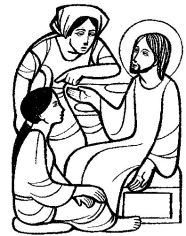
Many would have seen Mary sitting in a place generally reserved for men instead of getting on with a woman’s domestic work, which may well have been behind Martha’s complaint, “Come on Lord, get my sister to behave like a real woman!” In effect, Jesus reply, “Mary has chosen what is better…” suggests that he thought that there could be much more to being a ‘real’ woman than preparing meals, raising children and doing housework if that is what God has equipped you and called you to be (and actually, I believe that ‘real’ men can do those things too, as part of their calling to marriage and parenthood).
As Jesus travels to Jerusalem and a confrontation with the religious leaders of the day, everywhere he goes he is leaving behind evidence of just how radical, how boundary-breaking, the call to follow him must be.




 Pilgrim Traveller