

“Watership Down” is the story of a group of misfit rabbits who go through a whole range of difficult and deadly experiences on their journey to find a place where they can live safely and securely, led by Hazel, a rabbit who stepped up as leader when needed. Some see in it a bit of an allegory about the dangers of oppressive government and leadership, which caused China to ban the book!
Once the rabbits have settled on the Down, and the dangers are in the past, Hazel lives many more years than the two or three usually given to a wild rabbit. In the Epilogue of the book, we find him dozing and waking in his burrow on a blustery morning in March. On waking, the elderly rabbit realises that there is another rabbit ‘lying quietly beside him’.
As Hazel struggles to remember the rabbit’s name, he ‘saw that in the darkness of the burrow the stranger’s ears were shining with a faint silver light’. He is being visited by El-ahrairah, the immortal Prince of all rabbits. El-ahrairah has come to take the dying Hazel to join his immortal bodyguard, the Owlsa. Hazel leaves his body, which he doesn’t need anymore, on the edge of the ditch. Before leaving, Hazel pauses to watch his rabbits, and El-ahrairah reassures him: “You needn’t worry about them. They’ll be alright – and thousands like them. If you’ll come along, I’ll show you what I mean.”
I was sat in a coffee shop, when something in the Introduction to the new book I was reading reminded me of “Watership Down”, a book I read many years ago, and particularly the ending of its Epilogue. Quoted above.
The book is the recently published “The God Story” by Alain Emerson and Adam Cox. The book is an attempt to highlight the overarching themes of the Bible, to help people “find personal meaning within the grand narrative of God’s unfailing love and his awe-inspiring plans for humanity”.
I’ve only just started reading the book, so I can’t comment yet on how well it succeeds in its bold aims. The bit that started my rumination was:
“Our great ambition is to pass on The God Story to our generation and our children’s generation in the hope that its sacred themes will capture their hearts, shape their lives and catapult them right into the centre of a story still unfolding.” From the Introduction, p. 3
Since the age of 10 years, my life has inextricably found identity and inspiration in “The God Story”. So much of who I am, what I do and how I try to live my life has been influenced by not just the story, but a relationship with the God who is behind the story…as the Apostle Paul says to the people of Athens in Acts 17: 28, “in God with live and move and exist”. I believe that as I’ve found my place in God’s unfolding story, God has asked me to play my part in making sure that The God Story is faithfully and passionately passed on to future generations.
Like Hazel in “Watership Down” I’m getting older. The question the two books, so different in genre, have caused me to ask of myself is: “Have I faithfully handed on what God has given me”. I’m always relieved to remember that it’s Jesus who will build his church, not me, but in as much as God has invited me to join in that building project, have I been a good and faithful builder? Does my life reflect the Saviour I’ve lived with and for during 60-odd years? When I was inducted into one of my pastorates, someone gave me a word they felt was from God: “I want you to build something that lasts”.
It’s not just the act of handing on to the next generations either…the content of what we pass on matters too. Are we faithfully passing on the Gospel of Jesus or some culturally biased, denominationally dogmatic or personal interpretation, based on our experience as we live for Jesus in ‘our’ world?
That’s a difficult one to answer. It’s clear that certain projections of Christian faith are far from faithful to the Gospel (eg Christian Nationalism), but for the rest, is it just a matter of our personal preferences as we follow Jesus. How can we know what’s true?
To begin with, Jesus didn’t give us a rule book to work from. He did say the rules could be summed up as: “The most important commandment is this: ‘Listen, O Israel! The LORD our God is the one and only LORD. [30] And you must love the LORD your God with all your heart, all your soul, all your mind, and all your strength.’ [31] The second is equally important: ‘Love your neighbour as yourself.’ No other commandment is greater than these.”
Mark 12:29-31 NLT
So, if our gospel fails to reflect our love for God and our love for others (reflecting God’s unconditional love) and if it fails to faithfully hand on the whole sweep of God’s story of a lost and redeemed creation something must be wrong.
Jesus gave something better than a rule book…he filled every believer with the Holy Spirit, who he promised would: “…guide you into all truth. He will not speak on his own but will tell you what he has heard.”
John 16:13 NLT
And of course, the Spirit works in us, changing us to be more like Jesus, producing a character that reflects him (Galatians 5: 22-25)… does the faith we pass on reflect the character and person of Jesus?
This post is rapidly becoming like the introspective ramblings of an aging man, but I think it is asking questions of each of us, regardless of age or Christian maturity:
- Am I faithfully and lovingly handing on the faith I have received?
- Is the faith I’m handing on true to the whole God Story, of God’s loving quest to recover, redeem and restore his creation, culminating in the gospel of the life, death and resurrection of Jesus?
- Does my life now more fully reflect the Saviour who I claim to follow than it did when I started out?
Personally. I continue to ask myself these questions all the time, and each of us needs to ask these three questions as we continue to walk with Jesus on the path to becoming more like him, and encourage the generations that follow to do the same.

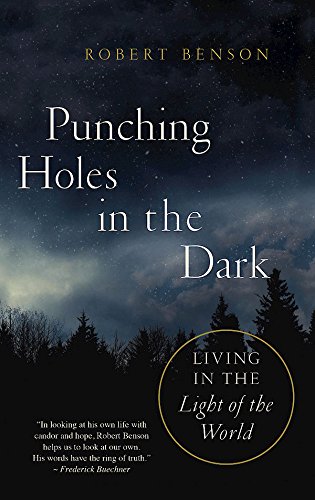 The world can often seem a dark and dangerous place, and it’s all too easy to become completely overwhelmed by the darkness. The latest book by one of my favourite authors, Robert Benson, “Punching holes in the dark” encourages us not to be so focussed on the darkness that we miss the beacons of light, large and small, which result from God’s activity in the world at large.


 One Jesuit author that I’ve found particularly useful is
  regularly. It suggests lots of ways to adapt and vary the traditional pattern of the Examen, focussing on different issues and areas of life. It is a great book!
 Pilgrim Traveller