
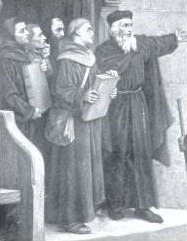
John Wyclif (c1329-1415) and the Lollards
John Wyclif regarded pilgrimage as ‘blind’, as Christ is everywhere ready to tale away sin. He also considered that pilgrimage did little to help the poor, and condemned the lechery which often accompanied pilgrimage. This demonstrates the extent to which pilgrimage was considered a sin-forgiving good work, accompanied by the earning or purchase of ‘indulgences’. He also considered the idea that a relic or image possessed some special virtue to be idolatrous:
“It is evident that images may be made both well and ill: well in order to rouse, assist and kindle the minds of the faithful to love God more devoutly; ill when by reason of images there is a deviation from the true faith, as when an image is worshipped”
Wyclif’s English followers, the Lollards, were very critical of pilgrimage, indulgences and all images and relics. They were part of a contemporary movement which interiorized religion, and as part of that considered only pilgrimage ‘of the heart’ rather that the need for a geographical journey. A Lollard Tract called The Lanterne of Light (1409/10) talks about how “true pilgrimage is done in six manners’:
- We are pilgrims from birth on our way to the heavenly city.
- We are pilgrims when we go to church.
- We are pilgrims when we visit the poor and distribute alms.
- We are pilgrims when we study holy writ and go to proclaim it.
- We are pilgrims when we go to a place where there is no priest, at the direction of God, as did Abram.
- We are pilgrims when we enter death, to ‘bliss or pain’.
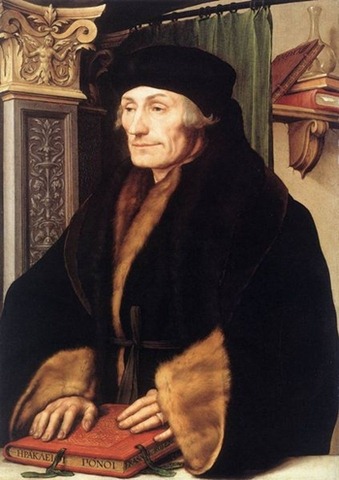 Erasmus of Rotterdam (c1466-1536)
Erasmus was one of the first to clearly bring out the vital importance of the parallel between the outward physical activity of travelling to shrines and the internal spiritual cultivation of the Christian character…the outward journey acts to facilitate the inward journey, and the outward without the inward is pointless as a spiritual discipline (my italics).
“You venerate the saints; you are glad to touch their relics. But you condemn what goods they have left, namely the example of a pure life.No worship of Mary is more gracious than if you imitate Mary’s humility. No devotion to the saints is more acceptable and more proper than if you strive to express their virtue. You wish to deserve well of Peter and Paul? Imitate the faith of the one, the charity of the other – and you will thereby do more than if you were to dash back and forth to Rome ten times. “
From ‘Enchiridion’ (1503)
Although Erasmus did not join the Reformers, he was a moderate, anxious to condemn and reform abuses within the church, and his thinking helped to form many later Protestant attitudes.

 Pilgrim Traveller