
I do not recall the whole conversation, but one day, however it happened, he said to me, “What is the opposite of love?”
I did not reply straight away. Hate seemed the obvious answer, but I had the feeling that answer was not going to fly. I was right.
“Fear,” he said. “Fear is the opposite of love.”
“This is how they will know that you love me,” said the One Who came among us, “that you love one another.”
And sometimes that begins with not being afraid of one another.
You cannot love those you fear. And we are called to love. Be not afraid.
Robert Benson “The Body Broken”, p97-98
As I said in the previous post, one of the things that makes our faith more real and attractive to others is that sense of our being a more accepting, more inclusive family. So why do we find it so hard to express our ‘oneness’?
 When I read the Gospels I am always surprised by the number of times people are told not to be afraid, from the annunciation by the angel to Mary, right through to the disciples after the resurrection. Fear seems to be such a natural reaction for us mortals…on many of the Gospel occasions fear was the only logical response to the supernaturally unexpected events, but we seem to get fearful about all manner of things that are much less logical.
Looking at the church today, I believe that one of the principal things that keeps us apart is a kind of fear driven by pride in our own ‘rightness’.
If our take on the Jesus-story and how we get to be a part of it is the only correct version, then it seems that fear must follow. How so?
It’s fairly easy to identify four areas in which our fear operates (there may be more…).
The first is a fear of that which is different…if my way is the right way and you differ from me you must be wrong. Your different views make me feel uncomfortable, so I must avoid getting too close to you.
The second is a fear of the unknown and the unfamiliar. We do things this way. I like how we do things…it’s to my taste. Your way is unfamiliar or unknown. I feel lost and uncomfortable.
The third is the fear that somehow your views and opinions will pollute me, will make it more difficult to adhere to the strict set of beliefs that constitute the orthodoxy of my tradition, my group.
And finally, if I do start to hear you, to enter into dialogue, to begin to accept that God may be so much bigger than my denomination or group, I run the risk of being criticised, excluded and vilified by others in my group who think I may be compromising, in error or falling away. Sometimes we Christians demonstrate so clearly why we need a Saviour!
Of course, when we exclude people on the basis of a different understanding of the Bible or our doctrines which we fear, we turn the Kingdom of God into an exclusive club for a number of favoured beings, who alone have access to the full counsels of God. It’s not just ‘theological heretics’ who have been excluded because of a particular reading of scripture, but down through the years women, divorced people and gay people have all been excluded on the basis of a particular interpretation of the scriptures.
This flies in the face of the Saviour who came to seek and save the lost and the God who is not willing that any should perish. We often seem to expend much energy deciding who’s in and who’s out. If only we devoted as much time to working out how not to put blocks in peoples way, by a harshness and lack of acceptance that does not reflect the love of God and the work of the cross.
And, critically, we need to remember that Jesus was habitually to be found with the very people that the religious people marginalised and excluded…perhaps by excluding them we are not to be found where Jesus is, and missing out on knowing him better.
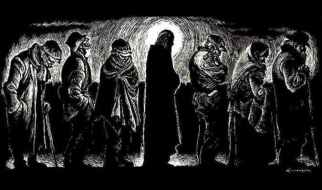

 Pilgrim Traveller