
 When was at primary school, my best friend was called Dave. As there were at least six Dave’s in our class (including him and me), the odds were forever in his favour.
Dave was always that bit better than me…he was brighter academically, better at sport and, unlike me, came from a family where both parents were Christians. When we both learned guitar, his long fingers proved more suited to the quick riffs of lead guitar while I strummed out the rhythm (I was, however, the better singer, so later on it was me, not him, that got to ‘front’ the band). When we went off to grammar school, he ended up in the top stream whilst I remained an ‘other’. Our differences seemed irrelevant to our relationship, and I spent quite a bit of time at his home, where I got to know his parents, who were also leaders in our church, fairly well.
A few months before I was due to take my GCE ‘O’ levels (yes it was a long time ago) I had a fairly serious sporting accident which resulted in at least four month’s absence from school. Despite the best efforts of my teachers, and some hard work on my part, I failed, or got disastrously low grades in all my exams. I was pretty devastated, especially as Dave passed with a string of ‘A’ grades.
Shortly after the results came through, I received a card from Dave’s parents with a simple message. The cover bore the words:
In any year…
“God asks not for success, but faithfulness.
Not for great skill, but that we do his will. “
They will never know how much their encouragement meant to me. By this time I had been a Christian for about six years, and had some inkling of what God’s plans for my future might involve. It mattered to me that despite failing at this early stage, God was still pleased with my effort and intent.
So, I stuck out the stigma of joining the general sixth form (for a year of doing it all again) before studying for my ‘A’ levels.
Any cursory read of my CV will amply demonstrate how apt were the words given me all those years ago. Choice and circumstance have given me many changes of job or career over the years (alongside a sense of constant vocation), but my sense of God’s approval for my efforts to live true to his calling remain undiminished. A while ago a friend from Manchester commented that I seemed to have a real ability to re-invent myself…I truly believe that the encouragement given me all those years ago was a vital part of this.
I was recently reading a pre-publication copy of a book written by a friend so that I could review it. It’s a book that reflects on a different way of being an ‘all of life missional disciple’. People always seem to need to know how it’s possible to measure the effectiveness and success of such an endeavour. It reads,
“As Christians, are we called to be obedient or successful (however that is to be defined”
Paul Keeble, “Mission With” page 121
It took me back to the message on the card I was given all those years ago, and I started to wonder where the original quote came from.
A bit of research turned up two similar quotations, although neither were quite the same. One was from Oswald Chambers, the other from Mother Theresa.
Mother Theresa says:
“God has not called me to be successful.
He called me to be faithful.”
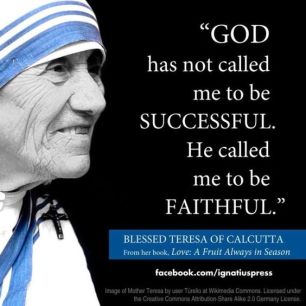
The Oswald Chambers quote is from “My Utmost for His Highest”, and reads,
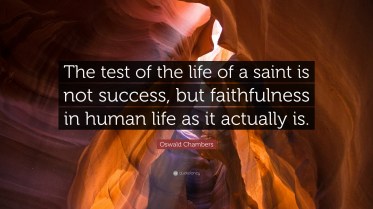
“The test of the life of a saint is not success, but faithfulness in human life as it actually is. We will set up success in Christian work as the aim; the aim is to manifest the glory of God in human life, to live the life hid with Christ in God in human conditions.”
I also came across the identical quotation, with two extra lines, on the website of an Irish Presbyterian church, but still without attribution.
God asks not for success, but faithfulness,
Not for great skill, but that we do his will.
Live so as to be missed,
Live with eternities values in view.
So, the fact is that I am still no closer to finding the source of my life-changing quotation.
Any offers?

 When we come to communion our focus is upon the things that Jesus achieved, what he did for us when he gave up his life for us. For the disciples it would have been very different. When they ate bread and drank wine they would remember a flesh and blood friend, who shared life with them, who laughed and cried, told stories, showed up hypocrisy and loved the people no one else did. Perhaps we should try to get beyond the benefits of Jesus death and think about our experiences of him in our lives and in the lives of others.
 Betrayal is an ugly thing. It sets aside love and trust for some personal gain. Many of us will experience the bitterness of betrayal, often from those closest to us. And more of us than will like to admit it will have betrayed the trust of someone else…we all have our price. Maybe we’ll even betray Jesus because following gets just too hard, too dangerous at times. I wonder what my 30 pieces of silver looks like…
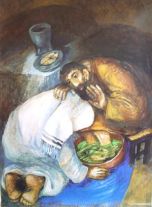 God’s Kingdom looks so different to any other. Those who are called to the responsibility and privilege of leadership need to be able to lead as Jesus did. They need to be prepared to teach and tell stories to win people’s hearts and take them along on the journey. They need to be prepared to love their followers even to the point of dying (whatever that might mean for them). And there will be more than a little work with a basin and towel, washing the feet no one else has bothered to wash. Take a long look at how leaders lead before you join a church…or decide to stay.
 Especially for those destined to lead, like Peter. When you fail, and experience the sweetness of Jesus’ forgiveness and find that he still gives you work to do, it’s meant to make you more empathic towards other failures…you’ve been there, you know how it feels. Even the strongest among us may plunge confidently into abject failure.
 Nothing is wasted in God’s economy. Our failures and successes in education. The dreams that wither and the dreams that thrive. The journey to a pig sty in a far country and the return to home and father when we finally come to our senses. The people who receive us and our message gladly and the ones who misunderstand, marginalise and persecute us. The prayers we pray, the answers we receive and the petitions as yet unanswered. Yes, sometimes Jesus provides what we need and more, but equally we need to make the most of the resources we can contribute to the relationship too.

 Pilgrim Traveller