
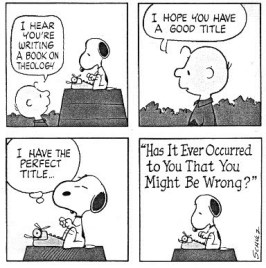
I came across this Peanuts cartoon…I hope it’s not a problem my copying it here! It seems to so aptly summarise the conversation between Jesus and the Sadducees, which in turn mirrors some of the controversies going on in parts of the church at present. Of course, admitting you might be wrong requires much humility…it does not imply a lack of assurance or trust in the Bible…but humility says “my interpretation or the interpretation of others that I favour may, just, be wrong”.
[27] Some of the , who say there is no resurrection, came to Jesus with a question. [28] “Teacher,” they said, “Moses wrote for us that if a man’s brother dies and leaves a wife but no children, the man must marry the widow and raise up offspring for his brother. [29] Now there were seven brothers. The first one married a woman and died childless. [30] The second [31] and then the third married her, and in the same way the seven died, leaving no children. [32] Finally, the woman died too. [33] Now then, at the resurrection whose wife will she be, since the seven were married to her?” [34] Jesus replied, “The people of this age marry and are given in marriage. [35] But those who are considered worthy of taking part in the age to come and in the resurrection from the dead will neither marry nor be given in marriage, [36] and they can no longer die; for they are like the angels. They are God’s children, since they are children of the resurrection. [37] But in the account of the burning bush, even Moses showed that the dead rise, for he calls the Lord ‘the God of Abraham, and the God of Isaac, and the God of Jacob.’ [38] He is not the God of the dead, but of the living, for to him all are alive.” [39] Some of the teachers of the law responded, “Well said, teacher!”
[40] And no one dared to ask him any more questions. [41] Then Jesus said to them, “Why is it said that the Messiah is the son of David? [42] David himself declares in the Book of Psalms: “ ‘The Lord said to my Lord: “Sit at my right hand [43] until I make your enemies a footstool for your feet.” ‘ [44] David calls him ‘Lord.’ How then can he be his son?”
[45] While all the people were listening, Jesus said to his disciples, [46] “Beware of the teachers of the law. They like to walk around in flowing robes and love to be greeted with respect in the marketplaces and have the most important seats in the synagogues and the places of honour at banquets. [47] They devour widows’ houses and for a show make lengthy prayers. These men will be punished most severely.”
Luke 20:27-47 NIV
It seems that the Sadducees were:
Blinkered
 They only accepted that the first 5 books of the Bible as being the pure and accurate scriptures, so any idea not found there (like the modern heresy of ‘resurrection’ which could only be backed up from dodgy prophets like Daniel) had to be wrong. They also seem to have read a fairly patriarchal view of women as the child-bearing property of men from there as well. They base their theology
  on a very small part of scripture, are quite certain that they, alone, have an exclusive, correct view of the truth. Does this sound familiar in a contemporary setting?
Jesus shows that they have failed to read and understand the sweep of even the small part of the OT scriptures that they rely on.
Blinded
Jesus used the focus on limited interpretation based on limited vision to raise another issue .I think that’s what all the stuff about David’s son being David’s Lord is about. It  seems that Jesus may be suggesting that they had a very limited view of who the Messiah was. The scriptures did indeed speak of him as David’s son (in the sense of being a descendant of King David…which Jesus was) but I think Jesus is keen to point out that the resemblance to David ends there. The Messiah was not only the son of David, but David’s Lord, the son of God, who would not come like a human ruler using power and violence to win his Kingdom.In Matthew’s gospel Jesus call the religious leaders blind guides, leading the blind into a pit…
Bankrupt
Finally, Jesus extends his criticism of the religious leaders to draw in the teachers of the Law as well. They, he says, have a tendency to be morally bankrupt and hypocritical. I am by no means anti-clerical (I’ve been a minister myself), but I can’t help noticing that the picture of the self-important, privilege-seeking teachers going about dressed in a way that makes them ‘stand out’ from the crowd bears a striking resemblance to a stereotype of a certain kind of vicar. Unfortunately, behind the show is a corrupt and greedy heart.
 I think that the scriptures should carry a ‘Health Warning’. Just about any position you care to mention can, and probably has, been justified by scripture, from slavery to racism, from oppression to greed.
It just shows what happens if you read the book without having a heart changed by a relationship with the one it sets out to reveal. Unless of course, my interpretation is completely wrong…

 Jesus did a lot of teaching using stories. Stories have several built in problems: the first is that it is a story and not a carefully crafted piece of moral teaching. The second is that depending on your personal situation, you may read or hear the story from the perspective of any one of the characters that it tells about…heroes and villains may very well be very subjective in that scenario.

 Posted with Blogsy
 Pilgrim Traveller