A brief review of “Practicing the Way…be with Jesus, become like him, do as he did” by John Mark Comer.
This book builds on some of the ideas introduced in John Mark’s previous book, “The Ruthless Elimination of Hurry”.
It focuses on three questions:
Who or what are you following?
Who or what are you becoming?
Who or what are you entrusting your life to?
The fact is, we’re all building our lives on someone or something, it’s an inevitable part of being human. There are people or philosophies of life we admire and seek to emulate; it’s not just religious people. And it follows that as people we are becoming like the people or things we admire…they affect our thinking, our behaviour and our relationships. In fact, every part of our lives.
In the world of the New Testament, such a person in Jewish culture would be called a rabbi (teacher). Jesus was a rabbi, who went around saying, “Come, follow me.” (Matthew 4:19). But what does that mean? John Mark Comer writes:
“Contrary to what many assume, Jesus did not invite people to convert to Christianity. He didn’t even call people to become Christians (keep reading…); he invited people to apprentice (disciple) under him into a whole new way of living. To be transformed.”
“Practicing the Way” p xvi
The rest of the book investigates how Jesus did this and suggests three “Goals” to pursue so we can be transformed into Jesus image by being with him, becoming like him and doing what he did.
The final bit of the book looks at the practical ways we can pursue the three goals, focussing on a having a Rule of Life lived out through nine spiritual practices that Jesus followed in his life.
A number of my friends found John Mark Comer’s “The Ruthless Elimination of Hurry” to be “a bit legalistic”, and I dare say might level the same criticism at this book.
However, it’s important to note that the close relationship to Jesus is key. Without it copying the things that Jesus said and did will not really change us one bit and is in danger of becoming a box-ticking kind of legalism.
I found this to be a most helpful book, and one I would not hesitate to recommend to new followers of Jesus or those mentoring them. There is even a helpful online course for groups (it might be possible to use as an individual too); you can find it here: https://www.practicingtheway.org/course .
I was reading a book about worship which talked about how we often invite Jesus to be present at our worship, taking him up on his promise in Matthew 18:20 (NIrV) “Where two or three people gather in my name, I am there with them.”
I got to thinking about times in the New Testament when we read about Jesus going to church – of course, I know the church hadn’t started then, but looked at times Jesus went to the Jewish equivalents, the Temple or the synagogue. I had a hunch that if Jesus turned up to our church meetings in the same way he is recorded on his visits to the Temple or synagogue, we might be a little more cautious about asking him to come and meet with us.
Jesus must have visited the Temple or synagogue quite a few times during his lifetime, but the Gospels record only four visits to the synagogue and 10 to the Temple. So, I have to ask what’s the significance, if any, of this handful that have been recorded?
A reading of the Gospels suggests three things:
In the gospel accounts Jesus’ harshest words are often reserved for religious people, especially their leaders.
In stark contrast, it’s often the people who least expect it, the lost, the least and the last that are helped, healed, commended and blessed by Jesus.
Jesus seems rarely to have visited ‘church’ without causing trouble or controversy.
I’m writing this in Holy Week, so a dramatic occasion when Jesus visited the Temple comes instantly to mind…that visit where he turned over a few tables and chased a bunch of traders out.
What got to him on this occasion? Was it that people failed to recognise “sacred space”? Did it have to do with the exploitation of worshippers by cheating traders and unscrupulous religious leaders?
Maybe most of all it was because they’d set up their market stalls in the part of the Temple courts where non-Jews were allowed to pray. So, a group of people who were discriminated against by the purity laws in Herod’s Temple were denied access to the one area where they could worship Yahweh…hence Jesus words, “Is it not written: ‘My house will be called a house of prayer for all nations’? But you have made it ‘a den of robbers.'” Mark 11:17 NIV (quoting Jeremiah 7:11).
I wonder, what tables would Jesus overturn in our churches? Would he be critical of our failures to be truly inclusive, our tendency to welcome only people like us and the tick-box mentality we apply to decide if people are in or out and theologically ‘sound’?
Here’s a few more things that might happen if Jesus came to our church:
Only a few people might recognise him, including the people who should know him the best (eg Luke 4:14 to 30).
Impure spirits won’t be able to hide from him (yes, impure spirits, even in church) (eg Luke 4:31 to 37).
People will be divided over his identity and authority (Luke 4: 16 to 30; Luke 20:1 to 8; John 7:25 to 52).
He might argue and debate with the leadership, tell pointed stories about them or preach sermons that would make people want to arrest him (Luke 20:9 to 38).
He might heal someone at an awkward time (Luke 6:6 to 11; Luke 13:10 to 17).
He might question our motives for giving (Luke 21:1 to 4; Mark 12:41 to 44).
So, a visit from Jesus might be messy and disruptive, and not the cosy, encouraging time that we hope for. That’s why gifts like prophecy are difficult to manage in our services. But for those who have open hands and hearts it might be just the time we need, a time when we become more aware of the bits of us that still don’t resemble Jesus very much, repent and receive the help of the Holy Spirit to transform them. That’s both for us as individuals and as a Christian community.
Come to think of it, when we’re together for worship Jesus always turns up. He’s full of grace and meets with us just as we are, but sometimes he loves us so much that he’s keen that we don’t stay as we are and says difficult things to us to make us aware of our need for change and our need of him. He loves us far too much to see things in our lives that stop us becoming more like him and not do anything about it.
It might be uncomfortable sometimes, but I’ll go on praying that Jesus is present when we gather for worship.
We turned up to our regular beach to walk the other day but found there was no beach to walk the dog on. We knew it was near high tide time but had failed to register that we were close to the Spring equinox. We haven’t lived in the area for long, so we’d never seen just how high a Spring tide could be on this coast. We opted for a walk in the dunes instead.
On Sunday we drove into a nearby small town. Our church meets in a building close to the sea, and as we walked there, we were treated to not only the sight of a really high tide, but on a still, almost windless day the rocks, the breakwater and the beach was being pounded by some enormous waves in a sea that boiled and crashed in a most intimidating way. I was glad to be on dry land and prayed there’d be no call out for the local lifeboat crew.
During the service we sat near the window with a grandstand view of the sea in all its fury and glory. It was a fitting reminder of God’s power and glory, in the words of C S Lewis, “of course he isn’t safe, but he’s good”. (The Lion, the Witch and the Wardrobe).
Those waves made me think of some words from a familiar psalm:
I hear the tumult of the raging seas as your waves and surging tides sweep over me. But each day the LORD pours his unfailing love upon me, and through each night I sing his songs, praying to God who gives me life.
Psalm 42:7-8 NLT
I’ve always identified with these words and found them to be deeply encouraging. Many commentators believe that this is a psalm (and Psalms 42 and 43 seem to actually be one extended psalm) about depression, after all a song is a great way to express just how you feel. This song reminds us that even in deep depression we can bring how we feel into God’s presence, without fear that he will be embarrassed or turn us away.
It’s a song of lament that asks the question , “Why, God?” – Why do I feel this way? Why do you seem to be so far away? Why do I feel so downcast and disturbed? Why have you forgotten me? Why are you allowing people to taunt me? Why have you rejected me? When will this end? It’s a song about the tension between faith and circumstances, a song that tries to understand why God “allows” us to suffer.
In this instant this depression is affecting the individuals ability to find joy in worship, which must have been doubly difficult for one of the sons of Korah, a member of the Levitical choir in the Temple…think Worship Leader! The fact is that “True believers do go through times of deep emotional suffering. They need our loving prayer and support, not our criticism and suspicion” Alan Palmer in “Discovering Psalms 1-72.
I am one such believer, suffering from depression at a number of times in my life. A number of years ago my wife, who is a qualified mental health therapist, put together a booklet which was sponsored by the charity “See Me” in Scotland. The booklet was a collection of stories from people with lived experience of mental health. I contributed a piece sadly written from my own perspective as a Christian in leadership.
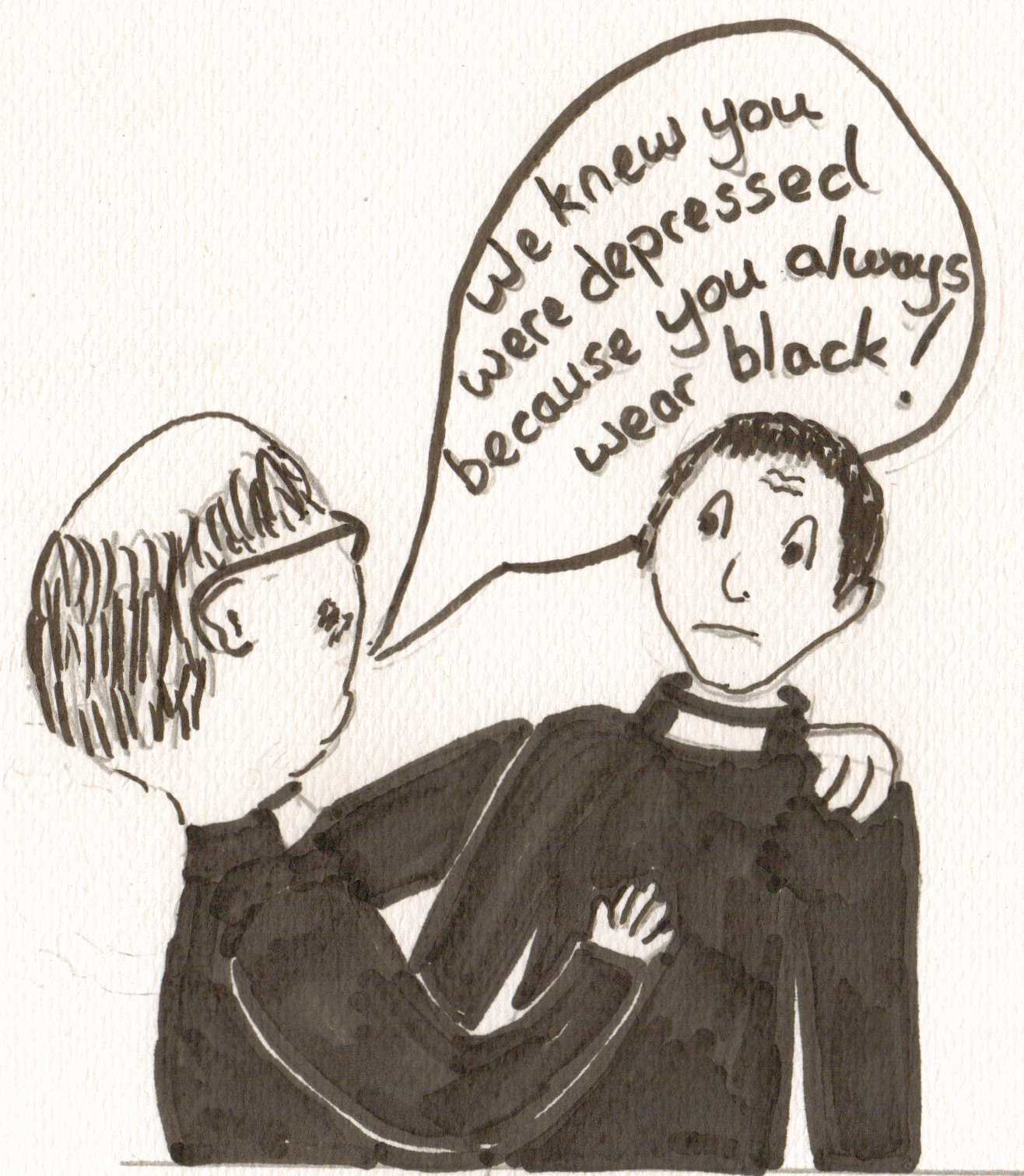
“The man was depressed, really clinically depressed. The church of which he was part could not cope with depression. He was dropped from the leadership and from teaching in the church without discussion. One of the senior leaders from the church came to visit.
“Of course,” he said seriously, “we could tell just by looking that you had a problem. We knew something was wrong in your life.” He paused.
“It’s the fact that you always wear black,” he said, without even the hint of a smile, “and that means you must be depressed (and in the leader’s view, depressed people are second-class Christians).
Years later he’s reading a frequented blog. There is a discussion about the wearing of black. The blogger posts…“Sometimes I wear grey to show my unbridled joy!”
The man, who has long since recovered, laughs out loud remembering the absurdity of the leader whose outlook was so “black”. But he is grieved at the ignorance and misunderstanding experienced by those suffering with mental illness, and he is angry at the church leader’s lack of resemblance to the One he claimed to follow.”
“Please Remove the Label”, compiled and edited by Wendy Ward
When we are depressed, when we are struggling to make sense of our lives and asking why God has allowed us to get to this state, the last thing we need is to be told that we are less than acceptable to the church and therefore, by extension, to God. It is at these times that we need every encouragement to continue to be people who have hope because they have Jesus; we need help to continue to stay close to him as we work through our questions.
If we look closely at the psalm we can learn a lot about how this son of Korah had become depressed and how he was working it through. He seems to experience six stages as he goes through his time of depression:
Separation 42:4 and 42:6. He was probably geographically away from the Temple and Jerusalem, and it was a painful place to be. To put it more generally, sometimes we’re just not in the place we want to be, whether that’s geographical, vocational or emotional.
Attack 42:3 and 42:9-10. He was being attacked, both for his lack of faith and for continuing to have faith when his circumstances were so dire. People who criticise, even Christians who criticise, can have such double standards.
Grief 42:3, 42:5, 42:7 and 43:2. He expresses an overwhelming sense of loss. Loss of companionship, loss of worship, loss of relationship with God. His heart is sick and broken.
However, even while he still struggles to feel ‘right’ again, his continuing faith propels him to co-operate with God’s spirit in the work of recovery, healing and restoration.
Survival 42:1-2. Like a deer in the desert seeking out water, the source of life, the man is longing for God, for the spiritual refreshment and life that comes from his presence. Even though he is struggling to find God in his circumstances he hasn’t stopped looking!
Cure 42:4, 42:5, 42:11 and 43:3. The man doesn’t just wait passively for God to sort him out, he has a strategy for recovery. He looks back, and remembers all that God has done in the past and looks forward expectantly to God doing it again…”I will yet praise him” (42:5 and 11; 43:5
Recovery 43:4-5. Above all, the man has not lost hope – “Put your hope in God” is his constant refrain.
The NIV translation of 42:7 is “Deep calls to deep in the roar of your waterfalls; all your waves and breakers have swept over me.” I have often wondered if the first part of the verse speaks of the discovery of God’s Spirit in the spirit of the man, a deep relationship that is not broken and offers hope even as “the waves and breakers have swept over” him.
Even in our times of darkest depression the Spirit of God calls out to us in the depths of our being that we are loved by God and there is hope – “ send me your light and your faithful care, let them lead me to your holy mountain, to the place where you dwell” 43:3.





 Pilgrim Traveller