
“ This is what happened to me. I came to a full stop. One day I was in my bishop’s study, as if in some eerily calm nightmare, hearing myself say these words: I cant do this anymore.”
Paul Swann
In a church where often so much emphasis is placed on success and strength, imagine being a church leader who is suddenly struck down by the raw experience of failure and debilitating illness, causing him to question the very foundations of his life, faith and ministry as he goes through a time in a wilderness of fatigue…
In 2016 the Francis Schaeffer Institute published the findings of a survey on clergy health and stress. They do not make for encouraging reading.
At least 90% of ministers feel honoured and satisfied to be in this role, and work hard at it because they genuinely care for people.
Unfortunately, it seems that such commitment comes at a cost, indeed that very commitment often makes it impossible to even notice, and therefore respond to, the results of stress and pressure in our ministry before we are close to breaking point.
A 2016 survey of pastors in the USA by the Francis Schaeffer Institute has some grim statistics:
- 54% of pastors work over 55 hours a week
- 57% can’t pay their bills without a second income
- 54% are overworked and 43% are overstressed
- 53% feel their training had not properly prepared them for the task.
- 35% battle depression
- 26% are overly fatigued
- 28% are spiritually undernourished and 9% are burnt-out
- 23% are distant to their families
- 18% work more than 70 hours a week and face unreasonable challenges
- 12% are belittled.
- 3% have had an affair
This does not paint a healthy picture of those who are called to model a healthy Christian life…
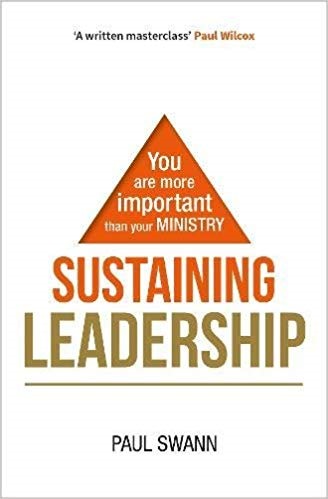 The church leader referred to in the opening paragraph was Paul Swann. After a number of years working hard in two growing parishes in the Diocese of Worcester he was forced to retire early due to chronic fatigue syndrome (ME). An enforced period of reflection helped him to put together the circumstances that had led him to this place, and to identify the many warning signs that had been ignored along the way.
He now serves as an adviser on spirituality, offers spiritual direction and leads retreats, from a place of weakness. His book, “Sustaining Leadership – you are more important than your ministry” is both a helpful preventative and ongoing resource for a life and ministry characterised by a balance of self-care with healthy ministry.
The book begins by telling Paul’s story of disintegration and reintegration, using this as a model for much sound and helpful advice. The chapter entitled “A question of balance” was very helpful and challenging, especially its advice on the keeping of a “Sabbath lifestyle”, and the “Soul Food” chapter amply repays the purchase price of the book and more.
The book finishes with a section on “Holding on to hope”, which invites the reader to move forward, not sustained by ‘false strength’, but rather from hope in a place of vulnerability. Faith and hope are often major casualties in this burnout process…the whole thrust of the book relates to keeping those essentials alive.

 Sometimes hearing from God can be painfully healing.

 Jesus suggests several ways by which we can make informed judgements about he source of spiritual authority. He says we should look at the character of the person making the claims or doing the work. We should look at the results of what is done or said…does the Kingdom grow and are lives changed for good as a result? Does what’s being said or done bring honour or dishonour to Jesus; is it consistent with the way he would have behaved and the things he would say?
 One of the reasons God gave us the church is to protect us from people claiming sources of authority which give them power over people. A church with shared leadership offers protection from abuse from one powerful leader who has become self-serving rather than a servant of Jesus and of the people he has been given to lead. A church where the people share in the decision making process by vote or consensus offers a further check and balance. There is no such thing as a power vacuum…where good decision making is lacking evil easily creeps in.
 Pilgrim Traveller