“In essentials, unity; in non-essentials, liberty; in all things, charity.”
Augustine of Hippo
I’m certain you will probably be familiar with Augustine’s much-quoted words…but how do they work out in practice?
Can we reach some agreement over what are the essential and non-essential features of the gospel, devoid of our upbringing and our cultural and denominational preferences?
Is it really possible to have a fundamentally different set of interpretations and practices and still demonstrate our overwhelming love for each other, showing that we “in humility value others above ourselves” (Philippians 2: 3)?
What is certain is that as we strive to understand and appreciate the differences in emphasis, interpretation and practice of others we not only increase our understanding of the ways of God, but we also grow in humility and avoid what one writer refers to as “the sin of certainty” (Peter Enns in the book of the same name).
If only we could put as much effort into finding the things that bind us together as we all too often spend finding ways to exclude and marginalise.
What follows is a brief survey of some of the things I’ve found helpful.
So, how do we come to ‘know’ what we know about God? The Methodist Church developed a helpful model for theological reflection (often referred to as the Wesleyan Quadrilateral)
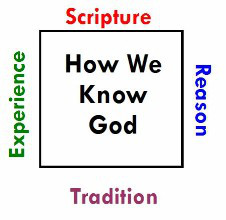
For most Christians, scripture is the prime source. However, few of us come to scripture unencumbered by the interpretive baggage of our denominational tradition and our personal experience of God, so perhaps scripture is not as definitive as we sometimes like to believe. Today, as the discipline of Biblical studies continues to throw light on the ancient texts in their cultural context, we can see that many of our cherished evangelical interpretations owe more to the reformers and the revivalists than to the early church…it is a minefield. Reason asks, “Can this doctrine be defended? Does it fit with the other things we know about God?”
We believe that the Holy Spirit is the “Spirit of truth”, who “will teach you all things and will remind you of everything that I have said to you” (Jesus in John 14). Perhaps the truth is much broader and complete if seen through the eyes of many believers, as the Holy Spirit uses scripture, tradition, experience and reason to open our eyes to the greatness of God and the things he does.
 The historic Creeds of the church, especially the Apostles Creed and the Nicene Creed may be helpful in determining what the early church saw as being the fundamentals of faith. Mostly they focus on the person and work of Jesus, which forms the bulk of both Creeds. Although a Creed is not an exhaustive statement of faith, I was slightly surprised by things that we focus on that don’t appear, or have only passing references.
It seems to me that who we trust and follow is much more important than what we currently believe. Perhaps our ‘non-negotiables’ should be a much shorter list than we often uphold?
I have to constantly remind myself that, in Biblical terms, I am a disciple, a student who still has much to learn from the Teacher…indeed the longer I have been a follower of Jesus, the more conscious I have been of my need to go on learning. And as a learner, grace, mercy and humility should be my constant companions.
A number of years ago I was one of the ministers of a large evangelical charismatic church in Manchester. The congregation which I led started to build relationships with the local Council of Churches. Some of our members felt that we had more to lose than to gain through this relationship, as we had little to learn from the other denominations.
I was especially friendly with the local Methodist minister, who invited us to join their church for their annual Covenant Service. Knowing that some of our members would struggle he invited me to preach at the service. So I announced that we would be closing down our church on that Sunday and all worshipping with the Methodists.
One of my younger leaders, let’s call him Wayne, was particularly antagonistic to the idea of the joint service. He really struggled with meeting with people who didn’t have their faith together like we did…
I don’t know if you’re familiar with the Methodist Covenant service, but they key part of the service is when all stand together and commit themselves before God to live their lives in Covenant with him, by praying the Covenant Prayer.
The prayer says:
‘I am no longer my own but yours.
Put me to what you will, rank me with whom you will;
put me to doing, put me to suffering;
let me be employed for you, or laid aside for you,
exalted for you, or brought low for you;
let me be full, let me be empty,
let me have all things, let me have nothing:
I freely and wholeheartedly yield all things
to your pleasure and disposal.
And now, glorious and blessed God,
Father, Son and Holy Spirit,
you are mine and I am yours. So be it.
And the covenant now made on earth, let it be ratified in heaven.’
After the service an obviously moved and chastened Wayne came to me.
“I hadn’t realised,” he said, “just how dedicated these Methodists are. That prayer…I really struggled to pray it myself.”
I think that for him it was a moment every bit as significant as the vision of the Apostle Paul on the roof at the home of Simon the Tanner…perhaps we all need such a moment to open our eyes to the ‘wideness of God’s mercy”.

If you want to share this:




 Pilgrim Traveller