
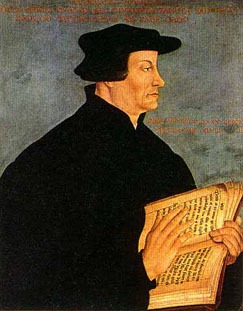
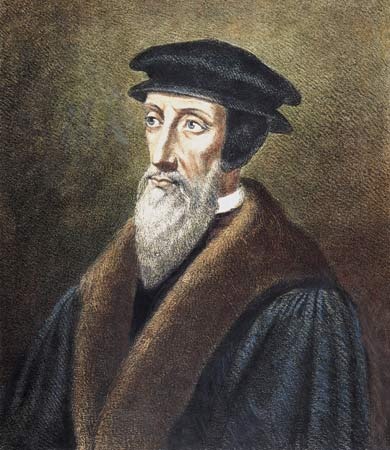

As might be expected, Zwingli and his followers were extreme in their condemnation of both pilgrimage and shrines and relics. For Calvin, pilgrimage itself was less of an issue, although he condemned the cult of the saints and images. This reflects his church-style, where church was a place of learning from the sacred book, not a sacred space in its own right. Pilgrimage had to do with meeting with fellow believers in the here and now, rather than trying to contact the saints of the past. And it certainly had nothing to do with earning God’s favour or forgiveness.
It is Martin Luther who seems to have most vehemently condemned pilgrimage and the associated practises. In his view, in the past Christ had been represented as an awesome judge, rather than a loving saviour, and that as a result “ all pilgrimages and the invocation of the saints stem from this view of Christ” (from a sermon on John’s Gospel).
He didn’t like images or the cult of the saints, but his strongest criticisms were reserved for indulgences and other ways of seeking to do good works to earn forgiveness.
His views on pilgrimage may be summed up by two quotes, which may be summarised as saying that pilgrimage is pointless and dangerous, and that true pilgrimage is an inner journey motivated by studying the scriptures.
“All pilgrimages should be stopped.There is no good in them: no commandment enjoins them, no obedience attaches to them. Rather do these pilgrimages give countless occasions to commit sin and to despise God’s commandments.” (from “To the Christian nobility”)
“In former times, saints made pilgrimages to Rome, Jerusalem and Compostela in order to make satisfaction for sins. Now, however, we can go on true pilgrimage in faith, namely when we diligently read the psalms, prophets, gospels and so on. Rather than walk about holy places, we can thus pause at our own thoughts, examine our hearts and visit the real promised land and paradise of eternal life.”
The Puritans in the UK seem to have thought in a very similar vein to Luther, whose works lead to the virtual ending of pilgrimage in the protestant world for many years, probably until in the nineteenth century protestants began to travel to the Holy Land, which in turn led to a new openness towards pilgrimage, which has, along with other cultural changes, led to a great resurgence in our own century.


 Pilgrim Traveller